


Cisco ASR vs ISR

Cisco manufactures data center equipment including a wide variety of routers that are suitable for small-scale and large-scale computing environments. Two of Cisco’s primary router lines fall under Aggregation Services Routers (ASR) and Integrated Services Routers (ISR), which are designed for two distinct purposes. Read on to find out what these routers are designed to do and learn about some of the key differences between Cisco ASR versus ISR routers.
Table of Contents
- Cisco’s Aggregation Services Routers Overview
- Cisco’s Integrated Services Routers Overview
- Key Similarities and Differences Between Cisco ASR and ISR Routers
- BrightStar Systems Resells High-Quality Pre-owned Cisco ASR Equipment
- Frequently Asked Questions
Cisco’s Aggregation Services Routers Overview

Cisco’s ASR series are best suited for enterprises and service providers. They are ideal for high-bandwidth applications, such as video streaming. The ASR series of routers currently includes the ASR 900 Series, the ASR 1000 Series and the ASR 9000 Series.
Of the three series, the ASR 9000 Series is the highest-end router; it has core routing capabilities in addition to edge routing capabilities. The ASR 900 Series and ASR 1000 Series only have edge routing capabilities, but all of of the ASR series routers can handle up to 100G Ethernet.
The ASR 9000 Series also uses different software from the other two series; it runs on IOS XR, whereas the ASR 900 Series and the ASR 1000 series run on IOS XE. Cisco’s IOS XR operating system is designed for Cloud-scale networking and allows for software image upgrades and module changes without impacting operations.
See how Cisco ASR routers compare with Juniper’s high-end routers, the MX Series.
Cisco’s Integrated Services Routers Overview
Cisco’s ISR series have edge routing capabilities and are primarily used by small businesses and branch offices that have small- or medium-sized networks. The ISR series of routers currently includes the ISR 800 Series, the ISR 1900 Series, the ISR 2900 Series, the ISR 3900 Series and the ISR 4000 Series.
ISR routers provide reliable, secure branch office connectivity and a robust set of features that enable cloud computing, secure networking, multimedia performance, and mobile connectivity. The ISR series also use Cisco’s IOS operating system, as opposed to IOS XE or IOS XR. Since ISR series routers are made for less computing-intensive environments, they have a much smaller footprint than ASR series routers. The ISR series also have lower maximum Ethernet speeds; the higher-end router of the ISR series, the ISR 4000, supports up to only 10G Ethernet.
Key Similarities and Differences Between Cisco ASR and ISR Routers
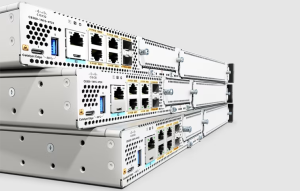
Although there are many similarities between Cisco Aggregation Services Routers and Integrated Services Routers, there are also several key differences, which is ultimately more important when considering purchasing Cisco ASR versus ISR routers.
The biggest difference between Cisco ASR and ISR routers is that ASR routers are for enterprises and service providers, whereas ISR are for customers with small- or medium-sized networks. In general, because the ASR series are designed for large-scale applications, they have more features and higher performance levels compared with ISR routers. For example, ASR routers can handle faster Ethernet, they have a higher port density, and the ASR 9000 Series is the only router series that has core routing capabilities.
In terms of similarities, both Cisco ASR and ISR routers offer secure WAN connectivity. They have also both been approved to secure sensitive data when configured with the PSN Interim IPsec Profile. And, although the Cisco ASR 9000 series provides cloud access like all the Cisco ISR series, the other two ASR series do not grant cloud access.
Compare Cisco routers to Juniper routers.
BrightStar Systems Resells High-Quality Pre-owned Cisco ASR Equipment

If you’re in need of Cisco ASR routers, BrightStar Systems has you covered.
We offer outstanding service, competitive prices, fast and safe shipping, a 1-year warranty, and expert knowledge in pre-owned, used and refurbished Cisco ASR routers. Our staff is trained and knowledgeable about all our products and can answer any specific questions you may have.
If you’re not quite ready to pull the trigger, check out the in-depth buying guide we put together, which walks you through the entire process of purchasing used network equipment.
Our customers include, but aren’t limited to, large-scale data centers around the world, and we offer wholesale and bulk purchasing to other dealers who resell products. We also purchase used products from businesses and consumers looking to decommission, liquidate, or upgrade their equipment.
It doesn’t matter if you’re purchasing Cisco ASR series routers, or any other of our Cisco networking equipment, all our products our are fully tested and come with a one-year, in-house warranty.
In addition to pre-owned Cisco hardware, we sell used Juniper and Arista networking hardware. Check out our Juniper MX vs Cisco ASR Routers page to see how those two router series compare.
And to see how Cisco’s hardware stacks up to Arista’s equipment — particularly Ethernet switches — take a look at our Arista vs Cisco comparison.
If you’d like more information on our Cisco Aggregation Services Routers , please contact us today.
Frequently Asked Questions
Cisco ASR (Aggregation Services Routers) are designed for high-performance edge routing, typically used by service providers. ISR (Integrated Services Routers) are more versatile and aimed at enterprise branches, supporting services like security and WAN optimization. Cisco ASR is used for high-speed data aggregation, providing scalable routing and services for service providers and large enterprises. It’s commonly deployed for WAN aggregation, edge routing, and core network infrastructure. ASR excels in high-performance, scalable routing for large-scale networks. It is ideal for service providers, handling massive traffic loads, and offering advanced features like MPLS, VPN, and QoS for efficient data transport. ASR is important because it supports high-throughput, scalable network architectures, enabling service providers to manage growing data demands. It ensures efficient data aggregation, robust security, and advanced routing, enhancing network performance and reliability. ASR routers may be more expensive than other solutions and require advanced network management skills. They are overkill for small networks and might not provide significant benefits in non-service provider or enterprise-level environments. ASR is a router. Specifically, it is part of Cisco’s router lineup designed for high-performance edge routing, providing advanced network services and high scalability for large enterprises and service providers. Cisco ASR routers can deliver speeds ranging from a few gigabits per second (Gbps) to over 100 Gbps, depending on the model and configuration. They are designed to handle high-performance tasks in large networks.