Arista DCS-7060DX4-32-F — 32×400G Spine Switch with Forward Airflow
The
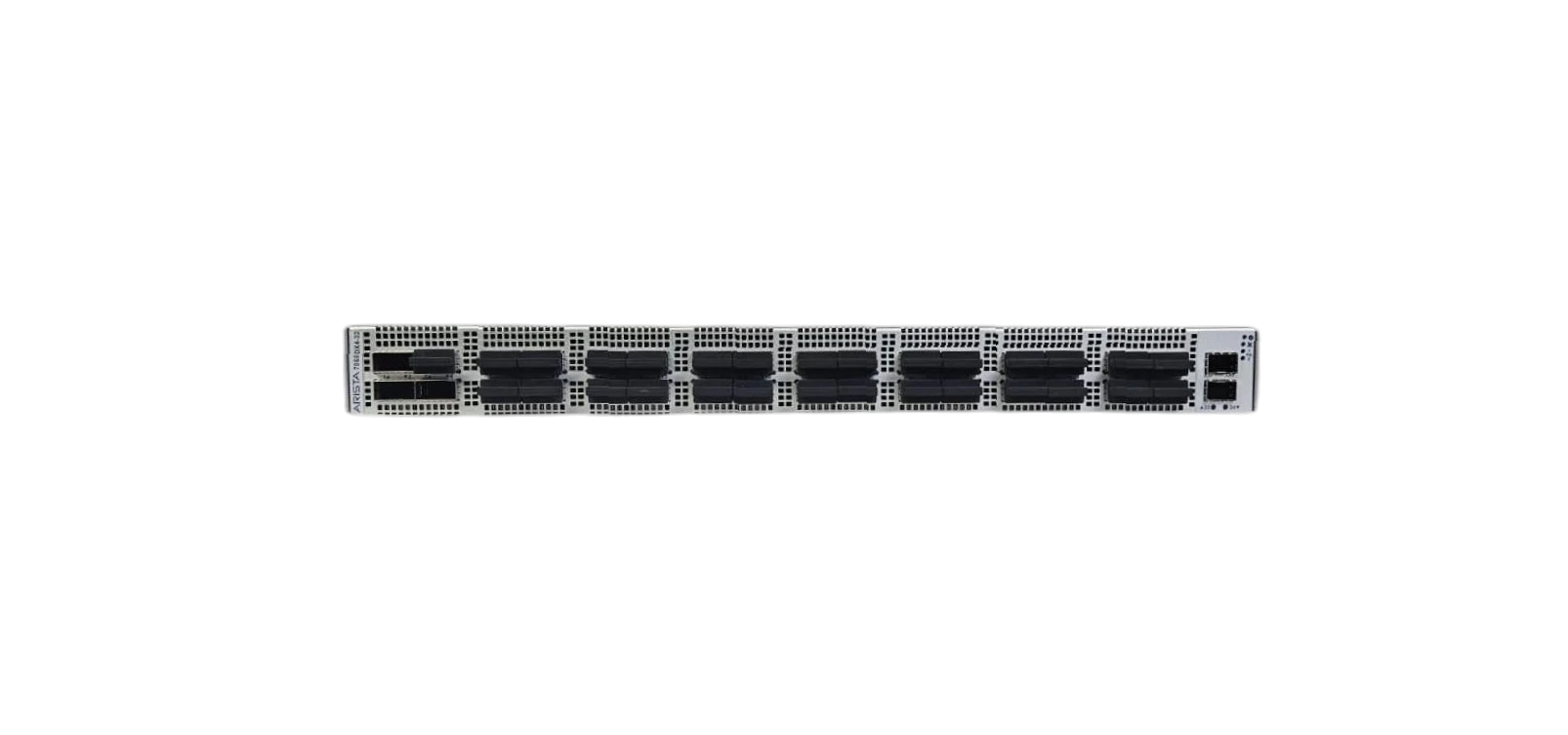
Arista DCS-7060DX4-32-F is a 1RU, 32-port 400G spine switch built on the 7060X4 platform. Delivering
25.6 Tbps of non-blocking switching capacity with
700 ns cut-through latency and a
64 MB shared packet buffer, it is purpose-built for the spine layer of high-density 100G/400G leaf-spine fabrics and next-generation AI/ML and storage networks. The DX4-32 delivers 4× the per-port bandwidth of the 7060CX series in the same 1RU form factor, powered by the
Broadcom Tomahawk 3 ASIC — the same density-per-rack-unit, with each port now operating at native 400GbE. The “
-F” suffix denotes
front-to-rear (forward) airflow, the standard configuration for traditional hot-aisle/cold-aisle data center designs where cool air is supplied from the front of the rack.
Key Features at a Glance
- 32 × 400GbE QSFP-DD ports supporting 400G, 200G, and 100G speeds — up to 128 × 100G interfaces with breakout
- 25.6 Tbps non-blocking switching capacity — full wire speed across all 32 ports simultaneously
- 700 ns cut-through latency for consistent, low-jitter performance across all active ports
- 64 MB shared packet buffer — approximately 3× deeper than the 7060CX2-32S (22 MB) for AI, storage, and bursty east-west workloads
- Broadcom Tomahawk 3 ASIC for proven 400G switching performance and broad EOS feature support
- Front-to-rear airflow (“-F”) for standard hot-aisle/cold-aisle data center deployments
- Redundant, hot-swappable power supplies with >93% efficiency and hot-swappable fan trays
- Full L2/L3 feature set: VXLAN, EVPN, MLAG, 128-way ECMP, BGP, and advanced routing
- Dynamic Load Balancing for AI/ML all-reduce and storage traffic patterns
- Rich telemetry: LANZ, sFlow, AEM, and streaming telemetry
- Runs Arista EOS® with open APIs, Python/Bash scripting, and CloudVision® integration
The DX4 Generation: 4× Per-Port Bandwidth on Broadcom Tomahawk 3
The
7060DX4-32 is the 400G successor to the 7060CX and 7060CX2 spine switches, built on the Broadcom Tomahawk 3 (BCM56960) ASIC. The generational upgrade delivers three meaningful advances over the 100G generation:
- 4× per-port bandwidth: Each QSFP-DD port operates natively at 400GbE — four times the per-port throughput of the QSFP28-based 7060CX/CX2. The same 32-port, 1RU form factor now delivers 25.6 Tbps of total switching capacity, four times the 6.4 Tbps ceiling of the 7060CX2-32S. For fabrics scaling to 400G leaf uplinks, the DX4-32 eliminates the need for oversubscription or additional spine units that 100G spines would require.
- 64 MB shared packet buffer: The Tomahawk 3 ASIC provides a 64 MB shared buffer pool — approximately 3× the 22 MB buffer of the 7060CX2-32S and 4× the 16 MB buffer of the 7060CX-32S. At 400G port speeds, burst events accumulate quickly; the 64 MB shared pool absorbs AI training all-reduce traffic, NVMe-oF storage bursts, and east-west incast events without packet drops or PFC-triggered back-pressure cascades that can stall GPU jobs.
- QSFP-DD interface versatility: The QSFP-DD connector form factor supports 400G, 200G, and 100G speeds within the same physical interface — allowing the DX4-32 to connect natively to existing 100G leaf infrastructure using breakout cables while simultaneously supporting new 400G leaf and spine deployments. A single DX4-32 spine can interconnect 100G and 400G tiers of the network without separate line cards or uplink modules.
For organizations running 7060CX or 7060CX2 spines today, the DX4-32 represents the in-family upgrade path: same EOS feature set, same management tooling, same 1RU footprint, with 4× the per-port bandwidth and a substantially larger buffer for the workloads that demand it.
25.6 Tbps Non-Blocking Architecture
The
DCS-7060DX4-32-F delivers
25.6 Tbps of full-duplex, non-blocking switching capacity across all 32 QSFP-DD ports. Every port operates simultaneously at 400G line rate without oversubscription — a non-negotiable requirement for spine switches where east-west bandwidth is the architectural constraint. This throughput ceiling holds regardless of traffic mix, packet size distribution, or active flow count, providing the consistent, predictable performance that modern leaf-spine and AI/ML fabric designs require. A single DCS-7060DX4-32-F spine can service up to 32 × 400G leaf switches at full line rate, or up to 128 × 100G leaf connections using 4×100G breakout — all without fabric head-of-line blocking.
700 ns Cut-Through Latency
Operating in cut-through switching mode, the
7060DX4-32-F delivers
700 nanoseconds of port-to-port latency with consistent, low-jitter performance across all 32 ports. This sub-microsecond performance is achieved at 400G speeds — a fundamentally harder target than 100G switching, given that 400G ports carry 4× the data volume per clock cycle. For general data center spine switching, distributed computing, AI/ML cluster interconnect, and storage networking, 700 ns represents excellent cut-through performance at 400G. Organizations requiring sub-500 ns latency for ultra-latency-sensitive workloads such as high-frequency trading should consider the
DCS-7060CX2-32S-F (450 ns, 100G) for those specific requirements.
Port Density and Multi-Speed Flexibility
The 7060DX4-32 provides
32 × QSFP-DD ports, each supporting multiple speeds and breakout configurations:
- 400GbE — native full-rate for 400G spine-to-spine, spine-to-leaf, or DCI connections
- 200GbE — dual 200G operation within a single QSFP-DD port for aggregation use cases
- 100GbE — backward-compatible 100G connectivity to existing QSFP28 infrastructure via adapter cables
- 4 × 100GbE breakout — connect up to 128 × 100G leaf switches from a single 1RU spine, using standard QSFP-DD to 4×QSFP28 breakout cables
- 2 × 200GbE breakout — dual 200G connectivity within a single QSFP-DD port for bonded uplinks or aggregation nodes
This per-port flexibility allows a single 7060DX4-32 spine to simultaneously service native 400G leaf switches, connect to existing 100G leaf infrastructure via breakout, and provide 200G connectivity for aggregation — covering an entire multi-generation migration without hardware changes. A fabric that begins with 128 × 100G breakout connections can progressively consolidate toward 32 native 400G connections as leaf hardware is upgraded, using the same DX4-32 spine throughout.
Optics, Cables, and Interoperability
The
DCS-7060DX4-32-F supports a broad ecosystem of standards-based
optics and cables:
- 400G QSFP-DD: 400GBASE-DR4, FR4, LR4, SR8, and 400G QSFP-DD DAC and AOC for short-reach spine-to-leaf connections
- 100G via breakout: QSFP-DD to 4×QSFP28 breakout DAC and AOC cables for connectivity to existing 100G leaf switches
- 200G via breakout: QSFP-DD to 2×QSFP28 breakout for dual 200G configurations
- Industry-standard optics: Compatible with IEEE 802.3bs (400GbE), 802.3cd (200GbE and 100GbE on 2-lane), and 802.3bj (100GbE) standards
64 MB Deep Shared Buffer: Built for AI, Storage, and Bursty East-West Traffic
The
64 MB shared packet buffer of the DX4-32 is one of its most consequential specifications for modern workloads. Unlike fixed-per-port buffer architectures, the shared pool dynamically allocates buffer capacity to the ports and queues that need it most — a critical property when traffic is asymmetric, bursty, or subject to many-to-one incast patterns. Three workload categories benefit directly:
- AI/ML training fabrics: Distributed training jobs using collective operations (AllReduce, AllGather) generate synchronized, simultaneous bursts from hundreds of GPUs toward the same destination. Without sufficient buffer, these bursts cause packet drops, trigger RoCE retransmissions, and stall training iterations. The 64 MB buffer absorbs these all-reduce events at the spine layer, keeping GPU utilization high and training time predictable.
- NVMe-oF and high-throughput storage: Storage reads and writes generate large, bursty transfers that arrive in waves. The DX4-32’s deep shared buffer prevents the head-of-line blocking and packet drops that force storage retransmissions and inflate I/O latency — particularly important when multiple compute nodes simultaneously read from the same NVMe-oF storage pool.
- East-west incast in leaf-spine fabrics: When multiple leaf switches simultaneously send traffic to the same destination through a spine, the spine port toward that destination absorbs an incast burst many times the individual leaf rate. The 64 MB shared pool provides the buffer headroom to absorb these events without drops, even when several incast events coincide at high port utilization.
At 3× the buffer depth of the 7060CX2-32S (22 MB) and 4× the depth of the 7060CX-32S (16 MB), the DX4-32 is the clear choice when workload characteristics demand spine-layer buffer headroom alongside 400G port density.
Dynamic Load Balancing
The
DCS-7060DX4-32-F supports
Dynamic Load Balancing (DLB), an Arista EOS capability that adapts traffic distribution across ECMP paths in real time based on actual queue occupancy and link utilization — going beyond static hashing to actively minimize congestion and balance spine load. In AI/ML fabrics where elephant flows from GPU-to-GPU transfers can overwhelm static ECMP, DLB redistributes traffic dynamically to avoid hotspots without requiring per-flow configuration. This is a material operational advantage over fixed-hash ECMP in high-utilization spine environments where traffic distributions are not uniform.
Spine-Optimized Fabric Support: VXLAN, EVPN, and 128-Way ECMP
The
7060DX4-32-F delivers the full Arista EOS spine feature set for modern data center and AI/ML fabric architectures:
- VXLAN: Spine-layer VXLAN routing for scalable overlay fabrics with large VNI counts across multi-tenant environments
- EVPN: BGP-based control plane for distributed MAC/IP learning, multi-tenancy, and seamless MAC mobility across the fabric
- Up to 128-way ECMP: Maximum path diversity across the spine layer, distributing east-west load evenly across all leaf uplinks and eliminating single-path bottlenecks
- BGP and IS-IS: Full-featured underlay routing for IP fabric, routed-spine, and eBGP-based CLOS topologies
- MLAG (Multi-Chassis Link Aggregation): Up to 64-way MLAG for redundant dual-homed leaf switch connectivity without STP convergence dependency
The DX4-32’s 64 MB buffer is particularly valuable in the spine role when multiple leaf switches simultaneously burst toward the same destination — a recurring pattern in AI training all-reduce operations and distributed storage reads where many-to-one traffic converges at the spine tier.
Telemetry, Monitoring, and Real-Time Insight
The
DCS-7060DX4-32-F includes Arista’s full telemetry stack for spine-layer observability at 400G scale:
- LANZ (Latency Analyzer): Per-port, real-time queue depth visibility and microburst detection — essential for diagnosing congestion events at the 400G spine without impacting production traffic. LANZ provides the visibility to detect buffer exhaustion before it causes drops, enabling proactive capacity management.
- sFlow: Continuous traffic sampling for east-west flow analysis, elephant flow detection, and capacity planning across 400G uplinks
- AEM (Arista Event Monitor): Rule-based, programmable alerting for link events, queue thresholds, and routing protocol state changes at the spine layer
- Streaming Telemetry: High-frequency counter and state export to gRPC collectors, Grafana, Prometheus, and third-party NMS tools — providing the per-second buffer and utilization visibility that AI/ML fabric operators require
EOS Automation and Extensibility
Running on
Arista EOS®, the
DCS-7060DX4-32-F is built for automation-first network operations:
- Native on-box Python and Bash scripting via the Linux shell for event-driven automation
- JSON-RPC eAPI for programmatic configuration — integrates with Ansible, Terraform, Salt, and Nornir
- CloudVision® for centralized configuration management, zero-touch provisioning, network-wide change control, and topology visualization
- OpenConfig and gNMI/gRPC for model-driven management and high-frequency streaming state export
- Zero-Touch Provisioning (ZTP) for fully automated day-0 configuration of new spine switches without manual intervention
Front-to-Rear Airflow and Data Center Fit
The “
-F” airflow configuration provides
front-to-rear (forward) cooling, where cool air enters from the non-port side of the switch and exhausts from the port side. This is the standard configuration for:
- Traditional hot-aisle/cold-aisle containment deployments where cold air is supplied from the front of the rack
- Racks where the majority of compute and network gear already uses front-to-rear airflow
- Colocation facilities that standardize on forward airflow for all customer equipment
- New data center builds following ASHRAE thermal guidelines
The DCS-7060DX4-32 is available exclusively in front-to-rear (“-F”) airflow. Organizations requiring reverse-cooled racks should evaluate other 7060 family models or consult with BrightStar Systems for alternative configurations.
Power Efficiency
The
DCS-7060DX4-32-F delivers approximately
17 W per active 400G port at typical utilization, with redundant power supplies rated at
over 93% conversion efficiency. For a 32-port 400G spine switch, this power envelope represents strong energy efficiency relative to the bandwidth delivered — providing approximately 4× the throughput of a 100G spine at substantially less than 4× the power draw. Dual redundant, hot-swappable power supplies ensure continuous operation through PSU failures without scheduled maintenance windows.
Compliance and Sustainability
- RoHS and WEEE compliant — Tomahawk 3 ASIC efficiency contributes to lower power per gigabit delivered
- Secure boot with digitally signed EOS images to prevent unauthorized firmware modifications
- Compact 1RU form factor maximizes 400G port density per rack unit in spine aggregation rows
Security Features
- Secure boot and digitally signed EOS images
- Role-Based Access Control (RBAC) for granular operator and administrator separation
- TACACS+/RADIUS/LDAP for centralized authentication and accounting
- ACLs for traffic policy and spine-layer segmentation enforcement at 400G line rate
- Control Plane Policing (CoPP) to protect the switch CPU from volumetric attacks targeting the management plane
Deployment Scenarios and Industry Applications
- AI/ML Training Fabrics: The primary use case the DX4-32 is engineered for — 32×400G spine connectivity with a 64 MB buffer for GPU cluster all-reduce traffic, DLB for real-time load rebalancing, and LANZ for microburst visibility during training runs. Supports RoCEv2 for GPU-Direct RDMA across the fabric.
- 100G/400G Mixed-Generation Leaf-Spine Fabrics: Using 4×100G breakout, the DX4-32 connects to existing 100G leaf infrastructure today while supporting native 400G leaf uplinks as the fabric is upgraded — eliminating the need to replace the spine tier during a generational transition.
- NVMe-oF and High-Throughput Storage Fabrics: 25.6 Tbps non-blocking capacity with 64 MB buffer depth for storage networks where burst tolerance at the spine layer directly determines storage I/O consistency and tail latency.
- Hyperscale and Cloud Data Centers: 25.6 Tbps non-blocking spine capacity with 128-way ECMP for full-bisection-bandwidth cloud fabric designs requiring 400G inter-pod connectivity.
- Large Enterprise Data Centers: Spine upgrade path for enterprise data centers moving from 100G to 400G, with backward compatibility through QSFP-DD multi-speed support preserving existing optics investments.
- HPC Clusters: High message-passing workloads generating synchronized incast patterns benefit from 64 MB buffer depth and Dynamic Load Balancing for consistent job completion times.
Lifecycle, Reliability, and Future-Proofing
The
7060DX4-32-F is built for long operational lifecycles with high MTBF ratings, field-replaceable fans and power supplies, and the consistent Arista EOS release cadence that network teams depend on for long-term supportability. As 400G becomes the standard fabric speed for AI/ML and hyperscale deployments, the DX4-32 is positioned as a long-lived spine asset rather than a transitional platform. Its multi-speed QSFP-DD ports preserve downward compatibility with 100G infrastructure as the surrounding fabric is progressively upgraded, protecting the spine investment across multiple refresh cycles of the leaf layer.
Competitive Comparison
- Versus Arista DCS-7060CX2-32S-F: The DX4-32 delivers 4× the per-port bandwidth (400G vs 100G), 2× total throughput (12.8 vs 6.4 Tbps), and approximately 3× the buffer depth (64 MB vs 22 MB). The CX2-32S-F retains advantages in cut-through latency (450 ns vs 700 ns) and cost, making it the right choice for HFT-sensitive workloads and fabrics remaining at 100G.
- Versus Cisco Nexus 9332D-H2R: Comparable 32×400G spine platform; the 7060DX4-32-F differentiates on Arista EOS automation depth, LANZ buffer telemetry, CloudVision integration, and Dynamic Load Balancing for AI workloads.
- Versus Juniper QFX5220-32CD: Similar 400G spine intent; the 7060DX4-32-F differentiates on EOS automation ecosystem, streaming telemetry integration, and native CloudVision management for multi-site deployments.
- Versus Arista DCS-7280DR3-24-F: The 7280DR3-24-F is a 400G switch router with 16 GB ultra-deep buffer and full MPLS/SR routing for DCI and WAN-edge roles. The DX4-32 is a pure L2/L3 data center spine optimized for intra-DC fabric — lower latency, lower cost, without the routing overhead of the 7280 platform.
Similar Arista 7060 Models to Consider
- Arista DCS-7060CX2-32S-F – 32×100G 7060CX2 spine with 22 MB buffer and 450 ns cut-through latency. The right choice when 100G is sufficient and sub-500 ns latency is required.
- Arista DCS-7280DR3-24-F – 24×400G switch router with 16 GB ultra-deep buffer, dual Jericho2 ASICs, and full MPLS/SR routing for DCI and WAN-edge deployments.
- Arista DCS-7050SX3-48YC8-F – 48×25G + 8×100G leaf switch; connects to the DX4-32 spine via 100G breakout uplinks in mixed 25G/100G leaf-spine fabrics.
Related 7060X Resources
Arista 7060 Series Switches: Architecture, Models, and Deployment Guide
The 400G Spine Built for AI, Storage, and Next-Generation Leaf-Spine Fabrics
The
Arista DCS-7060DX4-32-F brings together 25.6 Tbps of non-blocking capacity, 32 native 400G QSFP-DD ports, 64 MB of shared packet buffer, and the full depth of Arista EOS automation into a 1RU spine switch built for the workloads that define modern data center infrastructure — AI training, NVMe-oF storage, and high-density east-west fabrics. Its front-to-rear airflow makes it the natural fit for standard hot-aisle/cold-aisle data center deployments, and its multi-speed QSFP-DD ports protect existing 100G infrastructure investments while enabling a clean migration to 400G. Available from BrightStar Systems fully tested, reset to factory defaults, and backed by a 1-year in-house warranty.
Also available: DCS-7060DX4-32-R with rear-to-front airflow.
Related Arista 7060X Series models:
DCS-7060X6-64PE-F and
DCS-7060DX5-64S-F.