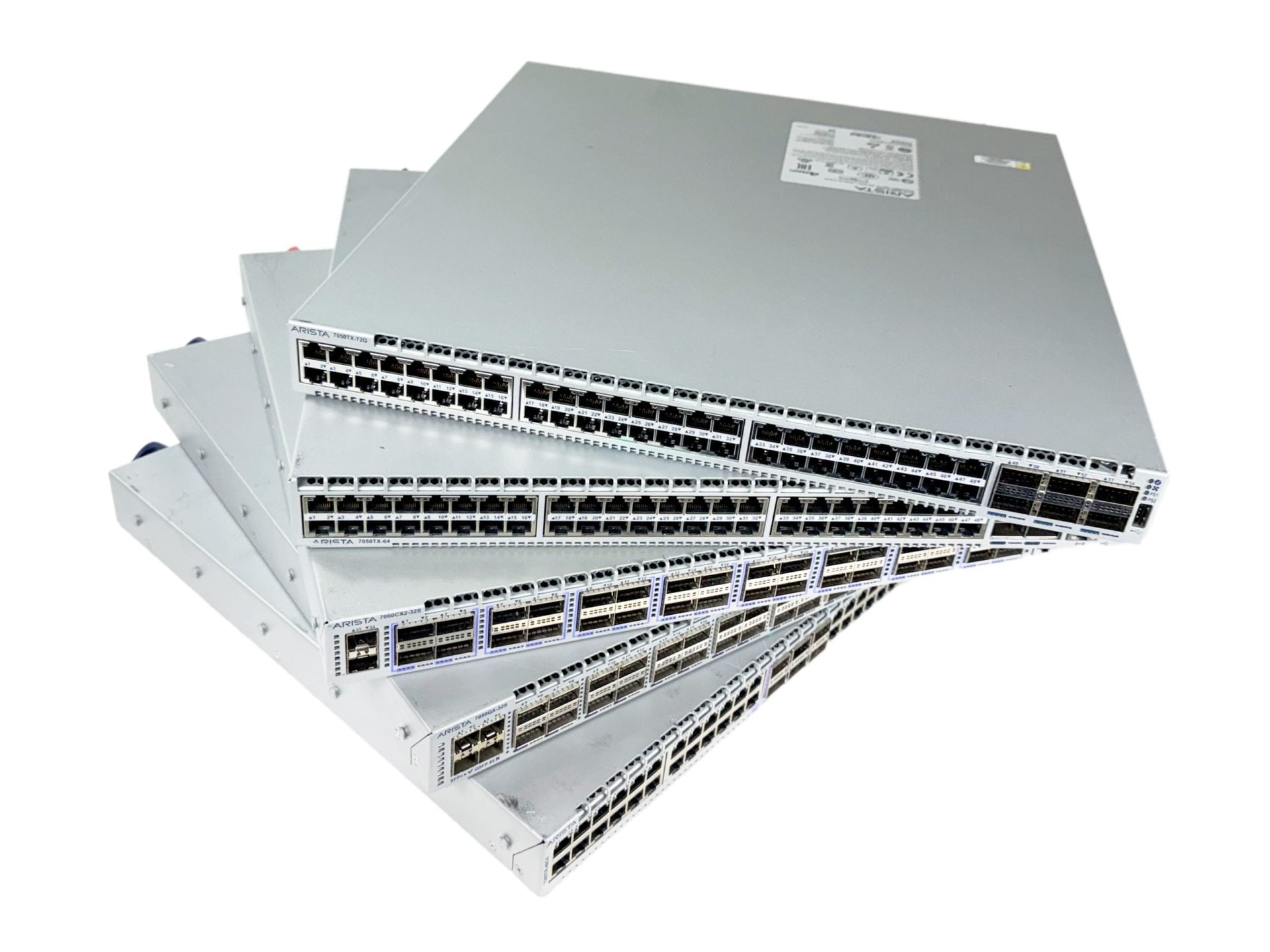
Arista DCS-7280R4-32DE-F — 32×800GbE QSFP-DD Switch Router with Front-to-Rear Airflow
The Arista DCS-7280R4-32DE-F is a 2RU switch router in the 7280R4 Series, delivering 25.6 Tbps of non-blocking switching capacity with 32 × 800GbE QSFP-DD ports and 8 × 25GbE SFP25 ports. Built on Arista’s 7th-generation deep buffer VOQ ASIC platform with 32 GB of packet buffer memory and 3.8 µs store-and-forward latency, the R4-32DE provides full Layer 2/3 switch router capabilities including BGP, OSPF, IS-IS, MPLS (LDP, RSVP-TE, BGP LU), SR-TE, EVPN, VXLAN, and 512-way ECMP. The platform features an Eight-Core x86 CPU with 64 GB DRAM, 480 GB SSD storage, and a field-serviceable 7001-SUP-L supervisor module that can be replaced without removing the chassis from the rack.
The “-F” suffix denotes front-to-rear airflow. The 7280R4-32DE is available exclusively in front-to-rear (-F) airflow configuration.
Key Features at a Glance
- 32 × 800GbE QSFP-DD ports supporting 800G, 400G (2×400G), 100G (8×100G), 50G, and 25G breakout modes — up to 256 network interfaces plus 8 SFP25
- 8 × 25GbE SFP25 ports supporting 25G, 10G, and 1G line rates
- 2 × QSFP-LS ports for dedicated ZR/ZR+ line system optics
- 25.6 Tbps non-blocking switching capacity (51.2 Tbps full-duplex) with 9.6 Bpps forwarding rate
- 3.8 µs store-and-forward latency with 32 GB VOQ deep packet buffer — eliminates head-of-line blocking
- Full Layer 3 switch router: BGP, OSPF, IS-IS, MPLS (LDP, RSVP-TE, BGP LU), SR-TE, EVPN, VXLAN, 512-way ECMP
- FlexRoute: Scalable IPv4 and IPv6 routing tables with flexible allocation of L2 and L3 forwarding resources
- Eight-core x86 CPU with 64 GB DRAM and 480 GB SSD running Arista EOS
- Field-serviceable 7001-SUP-L supervisor module — replaceable by a single engineer without disconnecting cabling or removing the chassis
- IEEE 1588v2 PTP with OCXO and SyncE hardware-assisted precision timing with PPS/10M/ToD inputs
- Telemetry: LANZ, Accelerated sFlow, Advanced Event Management (AEM), DANZ, Inband Network Telemetry (INT), streaming telemetry via gNMI and eAPI
- CloudVision integration, Zero-Touch Provisioning (ZTP), Python/Bash scripting, OpenConfig
- Hot-swappable dual PSU (1+1) and 4× N+1 fan trays; front-to-rear (-F) airflow
- 2RU form factor — 805W typical / 1874W maximum power draw
- BrightStar Systems: Available from BrightStar Systems fully tested, reset to factory defaults, and backed by a 5-year in-house warranty
Deployment Scenarios
AI/ML Data Center Spine — QSFP-DD Ecosystem
- 32 × 800GbE QSFP-DD ports deliver 25.6 Tbps non-blocking capacity for GPU cluster interconnect fabrics using the widely deployed QSFP-DD optics ecosystem
- QSFP-DD form factor provides backward compatibility with existing 400G QSFP-DD transceivers and direct-attach cables for mixed-speed deployments
- 32 GB VOQ deep buffer absorbs the bursty, incast-heavy traffic patterns characteristic of distributed training and inference workloads
- Cluster Load Balancing (CLB) provides AI-aware RDMA queue pair placement for granular global flow optimization across leaf-spine fabrics
Cloud and Internet Peering Router
- FlexRoute engine supports scalable IPv4 and IPv6 routing tables for full Internet routing table deployment at border and peering positions
- Line-rate MPLS label switching with LDP, RSVP-TE, and BGP Labeled Unicast (BGP LU) for carrier-grade transport and VPN services
- SR-TE with TI-LFA provides sub-50ms convergence for traffic-engineered paths across multi-domain WAN topologies
- 2 × QSFP-LS ports support 400G and 800G ZR/ZR+ DWDM coherent optics for DCI without external transponders
Data Center Interconnect (DCI)
- QSFP-DD form factor enables dense 800G and 400G connectivity using the same transceiver ecosystem deployed across existing data center infrastructure
- EVPN-VXLAN with MPLS underlay provides scalable L2 and L3 stretch between geographically distributed sites
- 2 × QSFP-LS ports support high-power 400G/800G ZR+ coherent optics for reaches up to 120 km on a single fiber pair
- 32 GB deep buffer handles the latency and jitter variations inherent in long-haul DCI traffic without packet loss
25.6 Tbps Non-Blocking VOQ Architecture
The DCS-7280R4-32DE-F delivers 25.6 Tbps of full-duplex, non-blocking throughput — 32 × 800 Gbps in both directions simultaneously. The Virtual Output Queue (VOQ) ASIC architecture maintains separate queues for each input-to-output port pair, eliminating head-of-line blocking. With a 9.6 Bpps forwarding rate, the switch operates at full line rate across all port combinations regardless of traffic mix or packet size distribution.
The 32 GB deep packet buffer is distributed across the VOQ structure, providing substantial burst absorption capacity. The VOQ deep buffer architecture handles transient congestion, TCP incast events, and bursty traffic patterns without triggering early packet drops or ECN marking.
3.8 µs Store-and-Forward Latency
The 7280R4-32DE-F operates in store-and-forward mode with a measured latency starting from 3.8 microseconds. The ASIC receives the complete packet, performs a full Layer 2/3 lookup, applies ACLs and QoS policies, and forwards the packet — all within 3.8 µs.
Port Configuration and Optics
The 7280R4-32DE-F provides 32 × 800GbE QSFP-DD ports, 8 × 25GbE SFP25 ports, and 2 × QSFP-LS ports:
- 32 × 800GbE QSFP-DD: Supporting 800G native, 2×400G, 8×100G, 8×50G, and 8×25G breakout modes.
- 8 × 25GbE SFP25: Supporting 25G, 10G, and 1G line rates.
- 2 × QSFP-LS: Dedicated line system ports for 400G/800G ZR and ZR+ coherent DWDM optics.
- Management: 1 × 100/1000 Mbps out-of-band management port + 1 × RS-232 RJ-45 console port + 1 × USB, independent of the forwarding plane.
- Maximum port configurations: Up to 32 × 800G, 64 × 400G, 256 × 100G, 256 × 50G, or 256+8 × 25G interfaces. Maximum 256+8 total interfaces.
Layer 2/3 Switch Router Capabilities
The 7280R4-32DE-F operates as a unified switch router with full Layer 2 and Layer 3 feature sets:
- BGP and Internet Routing: FlexRoute engine with scalable IPv4 and IPv6 routing tables and flexible allocation of L2 and L3 forwarding resources. Supports MP-BGP, BGP graceful restart, and 512-way ECMP.
- MPLS: Line-rate MPLS label switching with LDP, RSVP-TE, and BGP Labeled Unicast (BGP LU).
- Segment Routing: SR-TE, TI-LFA, OSPF-SR, ISIS-SR, and BGP-SR.
- EVPN and VXLAN: VXLAN Tunnel Endpoint (VTEP) and EVPN control plane for multi-tenant overlay networks. EVPN IRB for seamless L2/L3 overlays.
- Routing Protocols: OSPF, OSPFv3, IS-IS, RIPv2, VRF, BFD, Micro BFD, uRPF, VRRP/VRRPv3, VARP, PBR, BGP FlowSpec, and PIC.
- Layer 2: 802.1w/s Spanning Tree, RPVST+, 4096 VLANs, Q-in-Q, 802.3ad LACP, MLAG, Jumbo Frames, IGMP snooping.
- L2/L3 VPN Services: IP-VPN, EVPN over VXLAN and MPLS, LDP pseudowires, VPLS.
Precision Timing
- PTP IEEE 1588v2: Hardware-assisted Precision Time Protocol with OCXO oscillator supporting Boundary Clock and Transparent Clock modes, with PTP profiles G.8275.1, G.8275.2, and G.8261. PPS/10M/ToD inputs.
- SyncE: Synchronous Ethernet per ITU-T G.8264 for frequency distribution in carrier and 5G environments.
Telemetry, Monitoring, and Analytics
- LANZ (Latency Analyzer): Per-port, real-time microburst detection and queue depth monitoring at microsecond granularity.
- Accelerated sFlow: Hardware-accelerated sampled packet telemetry for flow analysis and capacity planning.
- Inband Network Telemetry (INT): Per-flow monitoring of traffic drops, latency, congestion, and network path in real-time.
- Streaming Telemetry: Real-time counter and state export via gNMI (gRPC) and Arista eAPI (REST). Supports OpenConfig data models.
- Advanced Event Management (AEM): Programmable event-driven automation within EOS.
- DANZ: Arista’s telemetry fabric for advanced mirroring, SPAN/TAP aggregation, and L2/3/4 filtering.
EOS Automation and Provisioning
The 7280R4-32DE-F runs Arista EOS, a modular operating system built on a standard Linux kernel where each process runs in its own protected memory space and communicates through an in-memory state-sharing database (Sysdb).
- CloudVision: Centralized configuration management, network-wide change control, topology visualization, and compliance monitoring.
- Zero-Touch Provisioning (ZTP): Automatic configuration download on first power-up via DHCP.
- Python and Bash: Native on-box scripting with full Linux shell access.
- eAPI (JSON-RPC): RESTful programmatic interface to all configuration and operational commands.
- OpenConfig and gNMI: Vendor-neutral data models and high-performance streaming RPC.
- NETCONF and RESTCONF: Standards-based configuration management interfaces.
Security
- Control Plane Policing (CoPP): Rate-limiting of CPU-destined traffic to protect routing stability
- ACLs: Ingress/egress access control lists at L2, L3, and L4 enforced in the ASIC at line rate
- TACACS+ and RADIUS: Centralized authentication and accounting for administrative access
- Secure Boot: Cryptographic verification of bootloader and EOS image integrity
- MAC Security, DHCP Relay/Snooping, ARP trapping for Layer 2 security enforcement
Note: Wire-speed TunnelSec encryption (MACsec, IPsec, VXLANsec) is available on the K-variant DCS-7280R4K-32DE-F. The standard R4-32DE does not include encryption.
Quality of Service (QoS)
- Up to 8 queues per port with strict priority, weighted round-robin (WRR), and weighted fair queueing (WFQ)
- 802.1p and DSCP classification and remarking
- ECN (Explicit Congestion Notification) marking for TCP-friendly congestion signaling
- PFC (Priority Flow Control) and DCBX (Data Center Bridging Exchange) for converged traffic
Physical Specifications
- Form Factor: 2RU — 17.3 × 3.46 × 24.74 inches (44 × 8.79 × 62.85 cm)
- Weight: 50.4 lbs (22.86 kg)
- Power: 805W typical / 1874W maximum; PWR-3211 AC or DC power supplies
- Redundancy: Dual hot-swappable PSU (1+1) and 4 hot-swappable FAN-7022HQ fan trays (N+1)
- Supervisor: Field-serviceable 7001-SUP-L module with Eight-Core x86 CPU, 64 GB DRAM, 480 GB SSD
- Storage: 480 GB SSD, 1 × USB port
- System Memory: 64 GB DRAM, 32 GB packet buffer
Lifecycle and Reliability
- Self-Healing Software: EOS includes Stateful Fault Repair (SFR) for automatic recovery from software faults without data plane impact, and Stateful Fault Containment (SFC) for fault isolation.
- In-Service Software Updates: Dual-partition boot with Smart System Upgrade (SSU) and Accelerated Software Update (ASU).
- Field-Serviceable Supervisor: The 7001-SUP-L supervisor module can be replaced in minutes without disconnecting network cabling or removing the chassis.
- BrightStar Systems 5-Year Warranty: Supplied fully tested, reset to factory defaults, and backed by a 5-year in-house warranty.
Scalability and Table Sizes
- MAC Addresses: 384K
- FlexRoute: Scalable IPv4 and IPv6 routing tables with flexible allocation of L2 and L3 forwarding table resources
- ECMP: 512-way
- Minimum EOS: 4.35.0
- EOS Feature License: Group 5
Similar Arista Models to Consider
- DCS-7280R4K-32DE-F: K-variant of the R4-32DE with TunnelSec wire-speed encryption on all QSFP-DD ports, large-scale routing with over 5M IPv4 routes, and Algorithmic ACLs (400K+ rules)
- DCS-7280R4-32PE-F: OSFP variant with 32 × 800GbE OSFP ports; same 25.6 Tbps throughput and 32 GB buffer in an OSFP form factor
- DCS-7280R4-64QC-10PE-F: Mixed-density variant with 64 × 100GbE QSFP28 + 10 × 800GbE OSFP ports; 14.4 Tbps throughput
- DCS-7280CR3K-96-F: R3 Series with 96 × 100GbE QSFP28 ports; 9.6 Tbps throughput; 16 GB packet buffer
Related 7280R4 Series Resources
For comprehensive technical documentation and comparative model information across the Arista 7280 family, visit Arista 7280 Series Overview.
Summary
The Arista DCS-7280R4-32DE-F is a 2RU switch router combining 32 × 800GbE QSFP-DD ports with 8 × 25GbE SFP25 ports and 2 × QSFP-LS ports, 25.6 Tbps non-blocking throughput, 32 GB VOQ deep packet buffer, and full Layer 2/3 capabilities including BGP, MPLS, SR-TE, EVPN, and VXLAN. The QSFP-DD form factor provides backward compatibility with existing 400G optics infrastructure. Featuring a field-serviceable 7001-SUP-L supervisor module, PTP with OCXO and SyncE precision timing, and comprehensive telemetry, the 7280R4-32DE-F is available from BrightStar Systems fully tested, reset to factory defaults, and backed by a 5-year in-house warranty.