
90 Day Resell / 1 Year User
Worldwide Shipping
Mon-Fri / 8am – 5 pm PST
2 in stock
What happens after requesting a quote:


The NVIDIA A100 Tensor Core GPU represents a significant advancement in computational power and efficiency. Built on the revolutionary Ampere Architecture, the A100 is designed to meet the demands of modern AI, data analytics, and high-performance computing (HPC).
Its architecture integrates advanced Tensor Cores and supports double-precision computing, making it ideal for a range of tasks from intensive training to complex simulations. With the A100, users can address a wide array of computational challenges with exceptional speed and precision.
Built on the revolutionary Ampere Architecture, the NVIDIA A100 redefines performance with its advanced Tensor Cores and 80GB of HBM2e memory. With over 2 terabytes per second of bandwidth, the A100 excels at processing large datasets and running complex models, making it ideal for AI, machine learning, and HPC tasks.
Tensor Cores with Tensor Float 32 (TF32) and mixed-precision capabilities boost performance by up to 20 times, accelerating AI training, simulations, and data analytics. Its scalable design allows it to meet the evolving demands of data-intensive workloads with efficiency and versatility.
Experience a quantum leap in performance with the NVIDIA A100, delivering up to 20 times the power of previous generations. Its versatility shines through its ability to handle diverse applications, from intensive AI training to complex data analytics. Multi-Instance GPU (MIG) technology further enhances its adaptability, allowing up to seven independent GPU instances for optimized resource utilization.
The NVIDIA A100’s Multi-Instance GPU (MIG) technology transforms GPU management by enabling a single A100 GPU to be partitioned into seven independent instances. This allows multiple users or applications to run simultaneously on a single A100 GPU, each with dedicated resources, ensuring no interference between workloads.
As a result, data centers can maximize efficiency, improve throughput, and achieve better cost-effectiveness by fully leveraging the GPU’s capabilities without sacrificing performance. MIG technology ensures that each workload receives dedicated GPU resources for optimal performance.
With exceptional scalability, the NVIDIA A100 seamlessly adapts from small-scale setups to extensive data center operations. Its integration with NVIDIA NVLink and NVSwitch technology enables efficient scaling to thousands of GPUs, optimizing performance for complex, data-intensive tasks.
A key element of this scalability is the NVLink Bridge, which provides up to 600 GB/s of bandwidth between GPUs, facilitating rapid data transfer and ensuring efficient multi-GPU configurations. This combination of flexibility and high-speed interconnects makes the A100 a powerhouse for demanding computational workloads.
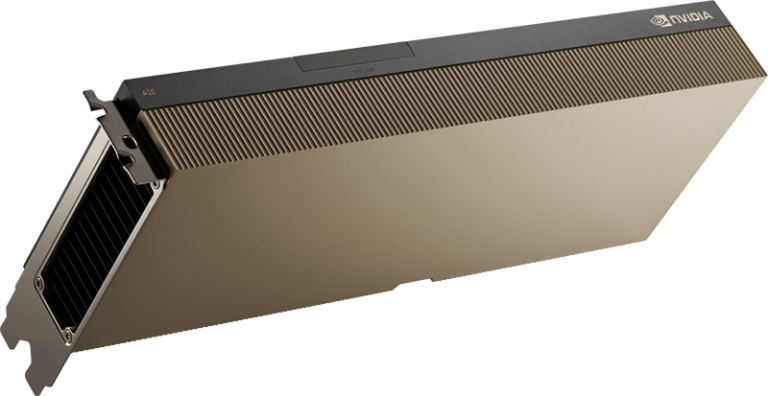
The NVIDIA A100 features strategically positioned PCIe connectors and offers dual-slot air-cooled or single-slot liquid-cooled form factors. This thoughtful design simplifies integration into various server setups and cooling solutions, enhancing overall system compatibility and user experience. The A100’s flexible form factors accommodate diverse deployment scenarios.
The bidirectional heat sink effectively dissipates heat, preventing overheating and maintaining consistent performance under heavy loads in high-performance environments, where GPUs often run at maximum capacity for extended periods. By efficiently dissipating heat, the A100 prevents thermal throttling, ensuring consistent performance and prolonging the lifespan of the hardware.
Incorporating programmable power management, the NVIDIA A100 allows for precise control over energy consumption. At maximum load, it consumes up to 400 watts, while power usage can drop to around 250 watts during idle or minimal load conditions.
This feature dynamically adjusts power based on workload requirements, optimizing performance and efficiency. Programmable power management helps reduce operational costs and supports environmental sustainability.
Prioritizing security, the NVIDIA A100 includes features like Root of Trust to ensure secure boot and firmware integrity. Adhering to stringent industry standards and certifications, it guarantees reliability and safety for enterprise applications. Its robust security measures protect against unauthorized modifications, maintaining the integrity of data center operations.
Additionally, the A100 supports secure virtualization and data encryption, enhancing protection for sensitive information in multi-tenant environments. The GPU’s hardware-based security features, combined with its comprehensive compliance with industry regulations, safeguard against potential vulnerabilities, making it an ideal choice for high-security data centers.
Integrating seamlessly with a range of data center solutions, including NVIDIA EGX™ and NVIDIA-Certified Systems, the A100 supports rapid deployment and scaling. Its compatibility with advanced software and infrastructure enhances performance across diverse data center environments, making it a valuable asset for modern computing needs.
Specialized features in the NVIDIA A100 address complex workloads with exceptional efficiency. Advanced Tensor Cores and support for multiple precision formats, including Tensor Float 32 (TF32) and mixed-precision, enhance performance for AI training, high-performance computing (HPC), and simulations. This capability enables the A100 to handle intricate computational challenges effectively.
Additionally, the A100 supports hardware-based secure virtualization and data encryption, boosting its utility in multi-tenant environments. These features ensure the A100 is well-suited for sensitive, high-demand data center operations.
Compared to its counterparts, the A100 differs significantly from the H100 and L4. The H100 offers improved performance and capabilities with its Hopper architecture, providing further advancements in AI and HPC workloads. On the other hand, the L4, while also powerful, is designed with a focus on energy efficiency and lower power consumption for specific applications. The A100’s balance of high performance and versatility, combined with its extensive feature set, makes it a robust choice for a broad range of computational needs.
Selling A100s? BrightStar also buys used NVIDIA GPUs and Spectrum switches. Sell your NVIDIA equipment for a written offer within one business day.
The NVIDIA A100 is used for advanced AI training, high-performance computing (HPC), and large-scale data analytics, excelling in tasks that require substantial computational power and memory.
The NVIDIA A100 GPU typically consumes around 400 watts of power under full load, though actual consumption can vary based on workload and system configuration.
The NVIDIA A100 is equipped with 80 GB of HBM2e memory, providing ample capacity for managing large datasets and complex computations.
The cost of an NVIDIA A100 GPU varies by retailer and configuration but generally ranges between $10,000 to $15,000. Prices may fluctuate based on availability and market demand.
The NVIDIA A100 was officially released in May 2020, making it a few years old but still relevant for many high-performance computing and AI applications.
The NVIDIA A100 is not officially discontinued but may be phased out as newer models, like the H100, and the Blackwell series become more prevalent. It remains available through various channels and secondary markets, but its production may decrease over time.
The NVIDIA A100 GPU is designed for long-term use in data centers, typically lasting 3-5 years before being replaced by newer technology. However, refurbished A100 GPUs can extend their useful life significantly, often providing reliable performance for an additional 2-3 years. Longevity depends on factors like usage, maintenance, and the quality of refurbishment. Refurbished units offer a cost-effective option while still delivering high-performance capabilities for demanding tasks.
The NVIDIA H100 GPU is generally considered superior to the A100, offering enhanced performance, improved architecture, and better efficiency for AI and data-intensive tasks.
The NVIDIA H100 and NVIDIA A40 are alternatives to the A100, offering different performance levels and features depending on specific computational needs.
The NVIDIA L4 GPU is more focused on efficiency and power consumption, while the A100 excels in raw computational power. The A100 is preferred for high-performance computing tasks.
The NVIDIA H100 GPU, built on the Hopper architecture, offers substantial performance improvements, better energy efficiency, and advanced features compared to the A100’s Ampere architecture.
The AMD MI250X is often considered an equivalent to the NVIDIA A100, offering competitive performance for data center and high-performance computing applications.
The NVIDIA A100 and RTX 4090 serve different markets. The A100 is optimized for data centers and AI workloads, while the RTX 4090 is aimed at high-end gaming and consumer applications. For data center tasks, the A100 is superior.
The NVIDIA A100 is designed for data centers with advanced AI and HPC capabilities, while the RTX 3060 is a consumer GPU for gaming and general use. The A100 has significantly more processing power and memory.
Competitors to the NVIDIA A100 include AMD’s MI250X, Google’s TPU, and Intel’s Xe GPUs, all offering different strengths for high-performance computing and ACompetitors to the NVIDIA A100 include AMD’s MI250X, Google’s TPU, and Intel’s Xe GPUs, all offering different strengths for high-performance computing and AI applications.I applications.