90 Day Resell / 1 Year User
Worldwide Shipping
Mon-Fri / 8am – 5 pm PST
What happens after requesting a quote:


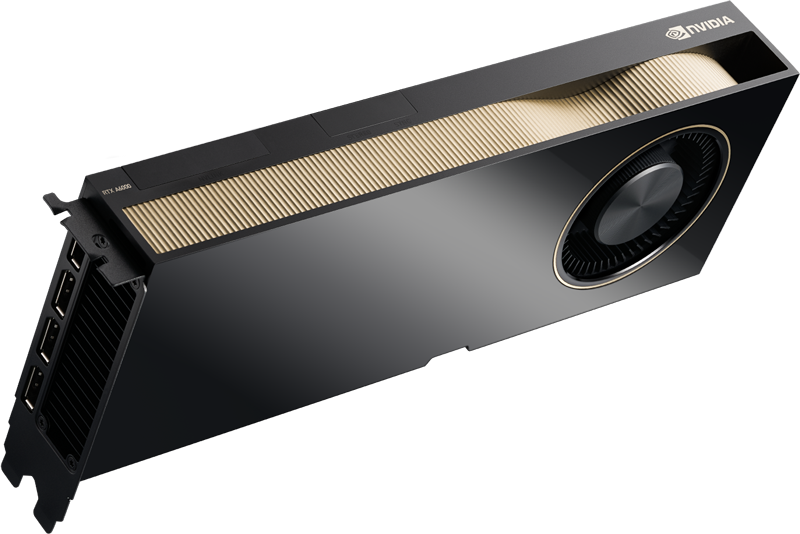
The NVIDIA RTX A6000 sets the gold standard for professional GPUs, delivering exceptional performance for graphics-intensive workflows, AI development, and computational simulations. Built on the cutting-edge NVIDIA Ampere architecture, this GPU redefines workstation capabilities for professionals in diverse fields like design, engineering, and media production.
The RTX A6000 GPU features a massive 48 GB of GDDR6 memory with ECC, making it ideal for handling complex data sets and large models. With 10,752 CUDA cores, 336 Tensor Cores, and 84 RT Cores, the NVIDIA A6000 delivers unparalleled rendering, AI, and compute power. Professionals benefit from lightning-fast single-precision performance of up to 38.7 TFLOPS, ensuring smooth execution of demanding tasks like 3D modeling and real-time simulation.
The Ampere architecture doubles processing speed for FP32 operations, boosting efficiency and throughput for graphics-intensive workflows. Professionals can achieve significantly enhanced performance for 3D design, simulations, and AI-driven applications without sacrificing power efficiency.
Third-generation Tensor Cores support Tensor Float 32 (TF32) precision, accelerating AI training up to 5X over previous generations. Additionally, these cores introduce structural sparsity, doubling inference performance for advanced machine learning models.
With second-generation RT Cores, the RTX A6000 offers up to 2X the ray tracing performance of its predecessor. This technology is essential for photorealistic rendering, enabling faster and more accurate simulations of lighting, shadows, and reflections.
The NVIDIA RTX A6000 delivers high performance with efficient power consumption of 300 watts and optimized thermal management. Its reliable thermal design, combined with its power connector configuration, ensures stability during extended workloads. It balances power-to-performance for demanding tasks while maintaining reliability in professional workstations and servers.
The RTX A6000 GPU features third-generation NVLink, enabling multi-GPU setups that pool 48 GB of memory, scaling to 96 GB for memory-intensive tasks like AI training and 3D visualizations. NVLink accelerates deep learning, scientific simulations, and high-end graphics, providing professionals with scalable computational power for complex workloads.
Supporting PCI Express Gen 4.0, the RTX A6000 offers twice the bandwidth of its predecessor, accelerating data-intensive tasks such as AI model processing and video editing. Professionals can expect faster data transfers, seamless GPU-to-GPU communication, and efficient use of GPUDirect for video and storage applications.
The NVIDIA RTX A6000 excels in server environments and multi-GPU setups, offering unmatched scalability and performance. Its third-generation NVLink technology connects two GPUs, pooling up to 96 GB of shared memory and delivering 112.5 GB/s of bidirectional bandwidth—perfect for AI training, large-scale simulations, and scientific computing.
With PCIe Gen 4.0 support and efficient thermal design, the A6000 ensures stable, high-speed performance in demanding server workloads. It also supports NVIDIA RTX Virtual Workstation (vWS) and Virtual Compute Server (vCS), enabling multi-user access and cost-effective virtualization for collaborative workflows.
Driver compatibility is critical for harnessing the full power of the A6000. NVIDIA provides regular driver updates tailored to the RTX A6000 GPU, ensuring seamless compatibility with the latest professional software, including CAD, 3D rendering tools, and AI platforms. Professionals looking to buy NVIDIA RTX A6000 GPUs can rest assured of reliable driver updates for optimal performance.
The RTX A6000 is designed to meet the needs of today’s high-performance workstations:
The NVIDIA RTX A6000 GPU is the preferred choice for professionals in various fields:
The RTX A6000 GPU supports emerging technologies like generative AI and next-gen VR. Its architecture handles complex AI model training and real-time inference, positioning it for future AI-driven advancements. Additionally, its powerful rendering capabilities make it ideal for creating immersive VR environments, future-proofing professionals in industries like entertainment, architecture, and education.
The A6000 supports key ISV certifications, ensuring compatibility with professional software like Autodesk, Dassault, and Siemens. It also integrates with NVIDIA’s ecosystem, including CUDA and TensorRT, enabling optimal performance for AI, scientific, and design applications, ensuring a reliable solution for advanced workflows.
Compared to the NVIDIA A40, the A6000 offers more memory and better ray tracing/AI performance. It outperforms the RTX A5000 in memory and core count, making it better for large-scale simulations. While the RTX A6000 price is higher than some models, its performance and memory capacity justify the investment. The RTX 6000 Ada Generation pushes further with ray tracing, but the A6000 remains the top choice for users needing maximum memory and computational power.
The NVIDIA RTX A6000 combines cutting-edge technology, unmatched power, and exceptional versatility, making it the ultimate solution for professional workstations. Its balanced power consumption and efficient thermal design ensure optimal operation for diverse workflows. Whether you’re designing the next architectural masterpiece, developing AI models, or creating breathtaking visual effects, the RTX A6000 empowers you to achieve your goals faster and more efficiently.
Experience the future of professional computing with the NVIDIA RTX A6000.
The NVIDIA RTX A6000 offers unmatched performance for graphics-intensive tasks, AI development, and computational simulations. With 48 GB of GDDR6 memory and advanced features like third-generation Tensor Cores and second-generation RT Cores, it provides exceptional speed, accuracy, and scalability, making it ideal for industries such as design, engineering, media production, and AI. The RTX A6000 excels in AI workloads due to its advanced third-generation Tensor Cores, which support Tensor Float 32 (TF32) precision and structural sparsity, enabling up to 5X faster AI training. It also delivers double the inference performance of previous models, making it an excellent choice for machine learning tasks and large-scale AI model training. The RTX A6000 supports third-generation NVLink, enabling multi-GPU setups that pool up to 96 GB of memory and provide 112.5 GB/s of bidirectional bandwidth. This scalability is perfect for demanding applications like AI training, scientific simulations, and large-scale 3D visualizations, ensuring high performance even in server environments and multi-GPU configurations. Yes, the NVIDIA RTX A6000 supports NVIDIA RTX Virtual Workstation (vWS) and Virtual Compute Server (vCS), enabling multiple users to access a single GPU for cost-effective virtualization. This makes it an excellent option for collaborative workflows and high-performance virtual workstations, allowing professionals to run demanding applications on shared resources. Although the NVIDIA A6000 is designed for professional use cases like data centers and virtual workstations, it can still run gaming applications. However, the A6000’s architecture is not as optimized for gaming as GPUs like the RTX 4090 or RTX 3090. For high-end gaming, those consumer-grade GPUs would deliver a better experience. The NVIDIA RTX A6000 was officially released in December 2020. It is part of NVIDIA’s professional GPU lineup based on the Ampere architecture, designed to deliver top-tier performance for demanding professional workflows in fields like AI, design, and 3D rendering. The RTX A6000 GPU is designed for high-performance professional applications such as 3D rendering, AI and machine learning model training, simulations, and computational tasks. It is commonly used in industries like design, architecture, media production, scientific research, and virtual reality (VR). Yes, the NVIDIA RTX A6000 supports 4K resolutions, making it suitable for complex visualizations and video editing. It includes four DisplayPort 1.4a outputs, which allow it to drive displays up to 8K, offering professional-grade visual performance for users working with high-definition media. Yes, the RTX A6000 is excellent for deep learning tasks. It features third-generation Tensor Cores optimized for AI workloads, which can significantly accelerate deep learning model training. With its 48 GB of GDDR6 memory and support for Tensor Float 32 (TF32), it is ideal for training complex neural networks and running AI models at scale. The AMD equivalent to the NVIDIA RTX A6000 is the AMD Radeon Pro W6800. While the W6800 offers competitive performance for professional workloads like 3D rendering and CAD, it does not match the RTX A6000 in terms of AI and machine learning capabilities, as the A6000 features specialized hardware like Tensor Cores for accelerated AI processing. The RTX A6000 is an extremely powerful GPU, delivering up to 38.7 TFLOPS of single-precision performance. It is equipped with 10,752 CUDA cores, 336 Tensor Cores, and 84 RT Cores, enabling it to handle the most demanding tasks in 3D rendering, real-time simulations, AI training, and high-end computational workloads. With 48 GB of GDDR6 memory, it excels in memory-intensive applications and large-scale simulations. The RTX A6000 and RTX 4090 are both powerful GPUs, but they are designed for different user needs. The RTX A6000 is a professional-grade GPU built for demanding tasks in 3D rendering, AI, scientific simulations, and workstations. It features 48 GB of GDDR6 memory, optimized for memory-intensive workflows. In contrast, the RTX 4090 is a consumer-focused GPU targeted at gaming and high-end consumer applications, offering excellent performance for gaming and real-time rendering. While the RTX 4090 has a higher clock speed and more CUDA cores, the A6000 excels in professional use cases, especially with its larger memory capacity and support for multi-GPU setups. Both the RTX 6000 and RTX A6000 are designed for professional workstations, but the A6000 offers superior performance and newer technology. The RTX A6000 is based on the Ampere architecture, providing faster processing and improved power efficiency compared to the older RTX 6000. Additionally, the A6000 has 48 GB of GDDR6 memory, which is an upgrade over the RTX 6000’s 24 GB, making it better suited for memory-heavy applications like AI and large-scale simulations. The A6000 also features enhanced ray-tracing and AI capabilities with third-generation Tensor Cores and second-generation RT Cores. The RTX A6000 and RTX 3090 are similar in terms of raw performance, but the A6000 is targeted at professional applications while the 3090 is aimed at gaming and high-performance consumer use. The RTX A6000 offers 48 GB of GDDR6 memory, which is significantly more than the 24 GB found in the RTX 3090, making the A6000 a better choice for professionals handling large datasets, 3D rendering, or AI model training. The A6000 also has enhanced support for professional workloads, certifications, and reliability, while the RTX 3090 is geared more towards enthusiasts and gamers. The RTX A6000 and the RTX 6000 Ada are both part of NVIDIA’s professional GPU lineup, but the RTX 6000 Ada represents a new generation based on the Ada Lovelace architecture, which offers improvements in performance and power efficiency. The RTX A6000 is based on the Ampere architecture, and while it still delivers exceptional performance, the RTX 6000 Ada comes with enhanced ray tracing and AI capabilities, as well as better performance in certain workloads like gaming and VR due to its next-gen features. However, the A6000’s larger memory and broader professional support make it a preferred choice for specialized professional workflows. The A100 and RTX A6000 are both high-end GPUs but serve different purposes. The A100 is specifically designed for AI and deep learning workloads, featuring Tensor Cores optimized for matrix calculations and high-throughput performance. It has 40 GB or 80 GB of HBM2 memory, designed for massive AI model training and scientific computing. The RTX A6000, on the other hand, is a more versatile GPU for professional workstations, providing 48 GB of GDDR6 memory and exceptional performance for 3D rendering, simulations, and AI inference tasks. The A6000 is ideal for users who need a general-purpose GPU with strong professional software support. The A40 and RTX A6000 are both powerful professional GPUs, but the A6000 outperforms the A40 in key areas. The RTX A6000 offers 48 GB of GDDR6 memory, while the A40 has 24 GB, making the A6000 more suitable for memory-intensive tasks. Additionally, the A6000 features third-generation Tensor Cores and second-generation RT Cores, providing enhanced performance in AI, machine learning, and real-time ray tracing. The A40 is still a powerful option but is generally aimed at less demanding professional workflows than the A6000. The A6000 and RTX 8000 are both high-end professional GPUs, but the A6000 offers improvements in architecture and power efficiency. The RTX A6000 is built on the Ampere architecture, which delivers better performance and power efficiency compared to the older RTX 8000. The A6000 also has 48 GB of GDDR6 memory, doubling the 24 GB found in the RTX 8000, making it better suited for memory-intensive tasks like AI training, simulations, and large-scale visualizations. Although the RTX 8000 is still a powerful GPU, the A6000 provides enhanced features for modern professional workflows. The RTX 6000, RTX A6000, and RTX 6000 Ada are all powerful professional-grade GPUs, but they cater to different needs and are based on different architectures, making each of them suitable for various workflows. While all three GPUs are designed for professional users, the RTX A6000 provides the best balance of memory, performance, and power efficiency for demanding workflows, while the RTX 6000 Ada brings even more power and future-proofing with its Ada Lovelace architecture. The RTX 6000 is an older model that still delivers solid performance but lacks the cutting-edge capabilities of its successors.