90 Day Resell / 1 Year User
Worldwide Shipping
Mon-Fri / 8am – 5 pm PST
What happens after requesting a quote:


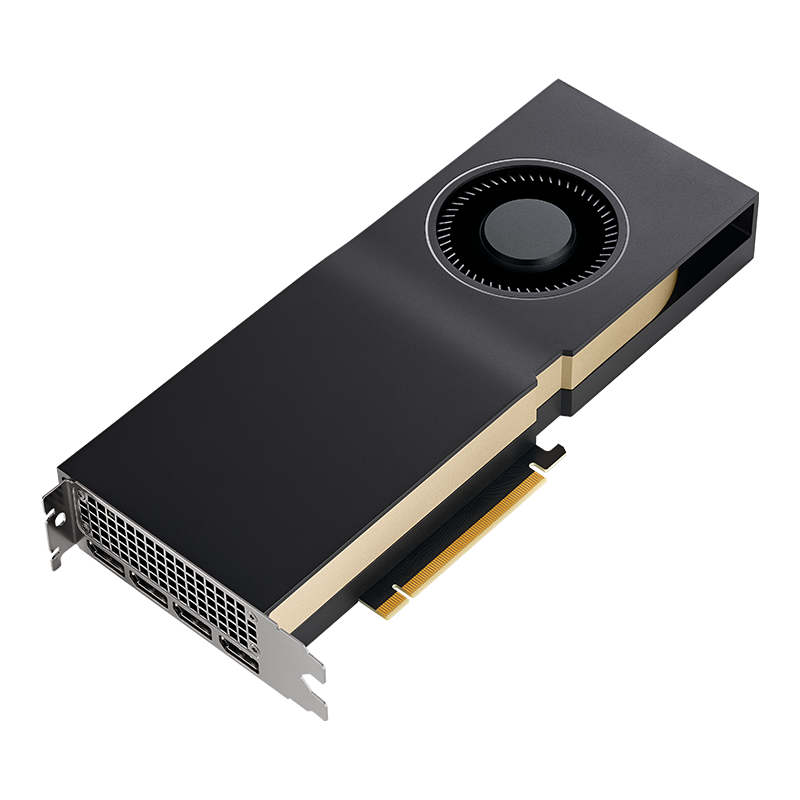
The NVIDIA RTX A5000 is designed for professional graphics, AI, and data science applications. It excels in deep learning tasks, offering powerful performance with its Tensor Cores for fast model training and inference.
The RTX A5000 is roughly equivalent to the AMD Radeon PRO W6800 in terms of 3D rendering and CAD performance. It also competes with the NVIDIA Quadro RTX 6000, though it benefits from newer architecture and power efficiency.
The NVIDIA RTX A5000 was released in 2020, as part of the Ampere architecture lineup.
The NVIDIA RTX A5000 features 24GB of GDDR6 memory with ECC, which ensures stability in demanding workloads.
Yes, the NVIDIA RTX A5000 is highly suitable for machine learning, especially for deep learning and AI research, thanks to its Tensor Cores and large memory capacity.
The RTX A6000 ADA offers better performance and more memory (48GB) than the RTX A5000, but the RTX A5000 provides a more cost-effective solution with similar architectural improvements.
Currently, the NVIDIA H100 Tensor Core GPU is the fastest GPU for machine learning, delivering extreme performance for large AI models and deep learning applications.The upcoming Blackwell architecture is expected to further enhance performance and efficiency, but as of now, the H100 remains the leading choice for machine learning workloads.
RTX GPUs are better for machine learning than GTX models, as they feature Tensor Cores designed for accelerating deep learning workloads.
The NVIDIA RTX A5000 has 8,192 CUDA cores, which significantly boost performance for rendering, AI, and computational tasks.
Yes, the RTX A5000 supports NVIDIA NVLink, enabling multi-GPU configurations for scaling memory and processing power.
The NVIDIA RTX A5000 is built on the Ampere architecture, which improves performance and efficiency with enhanced CUDA cores.
The RTX A5500 is the successor of the RTX A5000, offering improved performance and higher memory bandwidth, but at a higher price.
While the NVIDIA RTX A5000 is optimized for professional tasks like rendering and AI, it can run games, though it is not specifically designed for gaming like the GeForce RTX series.
The RTX A5000 is ideal for industries like AI, 3D rendering, media production, architecture, and engineering, providing high-performance for demanding tasks.
Yes, the NVIDIA RTX A5000 supports NVIDIA NVLink, enabling users to scale both memory and compute performance across multiple GPUs.
With a maximum power consumption of 230W, the NVIDIA RTX A5000 provides high performance while maintaining energy efficiency, ideal for extended workloads.
Yes, the NVIDIA RTX A5000 is certified by leading independent software vendors (ISVs), ensuring compatibility with applications in design, engineering, media production, and more.
The A6000 offers 48GB VRAM, double the A5000’s 24GB, making it ideal for memory-intensive workloads like large-scale simulations. However, the A5000 balances performance and cost for professional graphics, AI, and data science.
The A5000 delivers higher performance with more CUDA cores, Tensor cores, and VRAM (24GB vs. 16GB), making it better suited for demanding tasks, while the A4000 is a budget-friendly choice for mid-level workloads.
The 3090 targets gamers and creators, offering similar raw performance but lacking professional certifications and ECC memory. The A5000 excels in reliability, optimized drivers, and software compatibility for professional environments.
The 4090 outperforms the A5000 in raw gaming power, but the A5000 offers superior reliability, ECC memory, and software optimization for professional workflows like CAD, AI, and data science.
The A5000 offers ECC memory, professional drivers, and more VRAM (24GB vs. 10GB), making it suitable for professional tasks, whereas the 3080 is designed for gaming and general creative workloads.
The A5500 is a newer model with more cores, improved power efficiency, and faster memory, but the A5000 remains cost-effective for most professional applications requiring high performance.
The A5000 offers more CUDA and Tensor cores, higher VRAM, and greater overall performance, while the A4500 is a more affordable option for mid-range professional tasks.