
90 Day Resell / 1 Year User
Worldwide Shipping
Mon-Fri / 8am – 5 pm PST
2 in stock
What happens after requesting a quote:


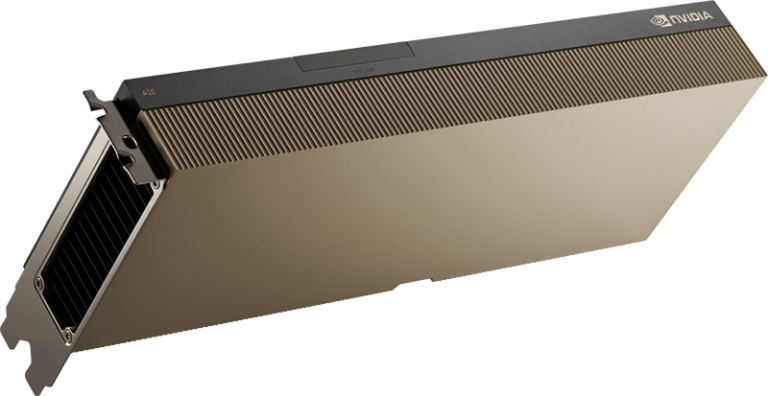
The NVIDIA A40 GPU represents a significant leap in graphics and computing power, engineered to meet the evolving demands of data centers and professional visualization tasks.
Powered by the NVIDIA Ampere architecture, the A40 is designed to handle everything from advanced AI workloads to 3D CAD simulations, making it an indispensable tool for industries that require high-end professional graphics combined with robust AI and compute capabilities.
At the heart of the A40 is its impressive architecture, which leverages second-generation RT Cores and third-generation Tensor Cores. The A40’s RT Cores provide up to 2X ray-tracing throughput compared to previous generations, enabling faster rendering of photorealistic content for design and simulation.
Meanwhile, the Tensor Cores boost AI and deep learning training by up to five times, making it a highly efficient solution for data science and AI research applications. This makes the A40 ideal for tasks such as AI denoising, virtual production, and scientific visualization.
Memory capacity is critical for high-performance workloads, and the NVIDIA A40 excels with 48 GB of GDDR6 VRAM, expandable to 96 GB through NVLink. This scalable VRAM efficiently manages large datasets for complex simulations, AI model training, and professional graphics rendering.
Unlike standard RAM, which serves the CPU, VRAM is designed for storing image data and textures, enabling faster rendering. With a memory bandwidth of 696 GB/s, the A40 handles demanding, data-heavy applications without bottlenecks. Its large VRAM capacity supports efficient parallel processing and fast data access, ensuring reliability in enterprise environments.
Supporting PCIe Gen 4, the NVIDIA A40 significantly improves data transfer speeds between the GPU and other devices, delivering twice the performance of its PCIe Gen 3 predecessors.
This high-speed connection is especially beneficial for workflows that involve heavy data throughput, such as 3D rendering, AI inference, and real-time simulations. The A40’s NVLink bridge further enhances GPU-to-GPU communication, with up to 112.5 GB/s of bi-directional bandwidth, allowing efficient multi-GPU configurations.
The NVIDIA A40 is purpose-built for virtualization, making it a top choice for data centers that rely on virtual desktop infrastructures (VDI). With support for NVIDIA RTX Virtual Workstation and Virtual Compute Server software, the A40 enables professionals to perform compute-heavy tasks remotely, from AI research to media production, with the same level of performance as a physical workstation. The A40’s secure boot with hardware root of trust ensures data center security and system integrity, critical for enterprises handling sensitive data.
With a power consumption of up to 300 W, the A40 offers up to twice the power efficiency of its predecessors, ensuring better performance without compromising on energy usage. It features a CPU 8-pin power connector located on the east edge of the board, supporting a variety of auxiliary power configurations, including a CPU 8-pin to PCIe 8-pin power adapter. This flexibility allows data centers to optimize power distribution across their systems efficiently.
The NVIDIA A40 supports a 2-slot NVLink bridge, enabling data transfer between two A40 GPUs. Each bridge features four NVLink links, with a data rate of 28.125 Gibps per lane, allowing a total maximum bi-directional bandwidth of 112.5 GB/s. For seamless integration into larger systems, the A40 offers two extender options—a long offset extender and a straight extender—allowing for greater customization and forward compatibility with future NVIDIA products.
Certified to meet various hardware and environmental standards, the NVIDIA A40 ensures reliability and sustainability for global data centers. It complies with EU regulations, including the Reduction of Hazardous Substances (RoHS) and Waste Electrical and Electronic Equipment (WEEE), as well as Joint Industry Guide (JIG) standards. The A40 also holds certifications for Windows Server 2008 R2 through 2019 and meets requirements from major agencies such as the FCC, CE, UL, and VCCI.
The NVIDIA A40 stands out as a versatile option among its peers, offering significant memory capacity and performance for high-demand applications.
The NVIDIA L4 is designed primarily for inferencing and smaller workloads, featuring 8 GB of GDDR6 memory. In contrast, the A40 boasts 48 GB of GDDR6 VRAM, making it far superior for data-intensive tasks such as AI model training and high-end graphics rendering.
The NVIDIA A10 features 24 GB of GDDR6 memory and is optimized for graphics workloads and virtualization. The A40 surpasses the A10 in memory size and bandwidth, making it a better choice for demanding applications in AI and professional visualization.
The A16 is optimized for multi-instance GPU (MIG) workloads, with 64 GB of GDDR6 memory. The A40, while having less memory, is designed for high-performance computing tasks. It delivers outstanding performance in single-instance scenarios, making it suitable for workloads that require more power and speed.
The A30 comes with 24 GB of GDDR6 memory and is suitable for various workloads, including AI and virtualization. However, the A40 outperforms the A30 with its 48 GB memory capacity and higher bandwidth of 696 GB/s, enabling it to handle more complex simulations and larger datasets.
While the A100 is a powerhouse with up to 80 GB of HBM2 memory, the A40 is more cost-effective for enterprises needing substantial memory for less demanding tasks. The A100 excels in deep learning and data science, but the A40 provides a strong balance of performance and efficiency for a wider range of applications.
The NVIDIA A40 features 48 GB of GDDR6 VRAM and 7,680 CUDA cores, making it suitable for various high-performance tasks. In contrast, the A6000 boasts the same VRAM but offers 10,752 CUDA cores and higher memory bandwidth, positioning it for more demanding applications like large-scale AI and deep learning.
The NVIDIA A40 GPU delivers cutting-edge performance for professionals in AI, design, media, and scientific fields. Whether handling real-time ray tracing, AI model training, or complex data simulations, the A40’s combination of memory scalability, PCIe Gen 4 support, and energy efficiency makes it an ideal choice for data centers worldwide.
With advanced features like NVLink connectivity, flexible power configurations, and virtualization support, the A40 is well-suited to drive the next generation of high-performance computing from the cloud to the edge.
Selling A40s? BrightStar also buys used NVIDIA GPUs and Spectrum switches. Sell your NVIDIA equipment for a written offer within one business day.
The NVIDIA A40 is designed for data centers and high-performance computing (HPC) applications. It excels in AI model training, machine learning, data analytics, and professional visualization tasks. With its massive memory and high bandwidth, it can efficiently handle complex simulations and large datasets. The NVIDIA A100 outperforms the A40 in raw processing power. The A100 features higher GPU clock speeds and a greater number of Tensor Cores, making it ideal for intense AI workloads. The A40, while powerful, is designed more for efficiency in multi-instance GPU configurations and professional visualization. The A6000 offers superior performance, featuring more CUDA cores, higher memory capacity (48 GB vs. 48 GB), and enhanced AI capabilities compared to the A40. The A6000 is geared towards more demanding workloads, making it suitable for advanced deep learning and large-scale simulations. The NVIDIA A40 was officially released in November 2020. It is part of NVIDIA’s Ampere architecture, designed to provide powerful capabilities for data centers and professional workloads. The NVIDIA A40 is equipped with 48 GB of GDDR6 VRAM. This substantial memory capacity enables it to efficiently manage large datasets and complex simulations essential for AI training and professional graphics rendering. Yes, the NVIDIA A40 supports single-precision (FP32) floating-point operations. This capability is essential for various applications, including AI inference and machine learning tasks that require quick calculations and processing of large data sets. Yes, the NVIDIA A40 is an excellent GPU, especially for data center and professional workloads. It offers a balance of high performance, substantial memory, and scalability, making it ideal for AI training, simulations, and advanced graphics rendering. The A40 offers more memory capacity (48 GB vs. 32 GB) than the V100 but has fewer Tensor Cores. While the V100 is optimized for deep learning tasks with high throughput, the A40 excels in versatility for both AI training and professional visualization. The L40 is a more specialized GPU designed for specific workloads, particularly in AI inference and low-latency applications. The A40, however, offers broader versatility, supporting various tasks, including data processing, AI training, and professional rendering. The NVIDIA A40 is equipped with 144 Tensor Cores, which significantly accelerate matrix operations used in deep learning tasks. This enables efficient training and inference for AI models while improving overall performance in relevant applications. No, the NVIDIA A40 is not a dual-SIM GPU. It is a dedicated graphics card designed for high-performance computing and does not feature SIM capabilities, as these are typically associated with mobile devices. Key specifications of the NVIDIA A40 include 48 GB of GDDR6 VRAM, a memory bandwidth of 696 GB/s, and a GPU clock speed of 1305 MHz base and 1740 MHz boost. It supports PCIe 4.0, NVLink, and has 144 Tensor Cores for AI workloads. The NVIDIA A40 has a total board power of 300 W. This power consumption ensures optimal performance while allowing for efficient management in data center environments, balancing performance and energy efficiency effectively. The NVIDIA A40 uses passive cooling solutions, requiring adequate airflow within the server chassis. Compatible cooling methods include server-grade air cooling systems and liquid cooling solutions to maintain optimal operating temperatures in data center environments. The A40 is optimized for AI model training, machine learning, data analytics, and professional visualization tasks. Its large memory capacity and high bandwidth make it well-suited for handling large datasets and complex simulations. The NVIDIA A40 supports advanced ray tracing capabilities, enabling photorealistic graphics and complex lighting simulations in real-time. With its powerful GPU architecture, the A40 excels in rendering detailed scenes quickly, making it ideal for AI workloads, professional visualization, and high-performance computing applications. The A40 performs exceptionally well in virtualized environments, supporting Multi-Instance GPU (MIG) configurations. This allows multiple users or workloads to share the GPU’s resources efficiently, maximizing utilization and providing flexibility in resource allocation. For optimal performance, the recommended system configuration for the A40 includes a server with PCIe 4.0 support, at least 32 GB of system RAM, and a powerful CPU. Adequate cooling and power supply rated for 300 W are also essential. Yes, the A40 is compatible with major AI frameworks, including TensorFlow, PyTorch, and Caffe. Its architecture and Tensor Cores enhance performance for AI and deep learning tasks, making it an ideal choice for developers and researchers.