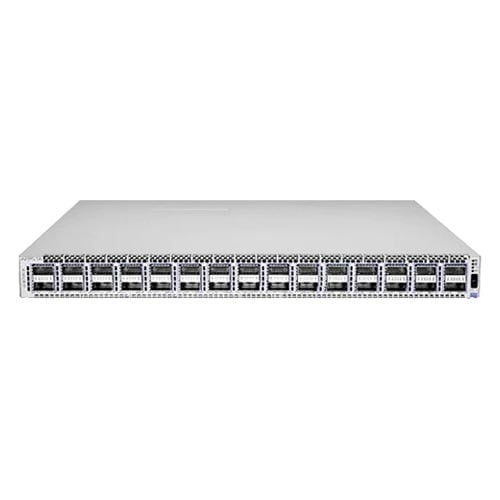
Arista DCS-7280CR2K-30-F — 30×100GbE QSFP100 Switch Router with Front-to-Rear Airflow
The
Arista DCS-7280CR2K-30-F is a 1RU switch router in the 7280R2 Series, delivering
6 Tbps of non-blocking switching capacity with
30 × 100GbE QSFP28 ports supporting wire-speed forwarding of 100GbE, 50GbE, 40GbE, 25GbE, and 10GbE traffic. Built on a advanced ASIC platform with
12 GB of packet buffer memory,
3.8 µs store-and-forward latency, and
2.51 Bpps forwarding rate, the 7280CR2K-30 provides full Layer 2/3 switch router capabilities — BGP, MPLS, Segment Routing, EVPN, VXLAN, and 128-way ECMP — with expanded FlexRoute supporting
over 2M IPv4 routes. The R2K variant includes
AlgoMatch for advanced policy-based forwarding and
Accelerated sFlow for high-speed telemetry. The “
-F” suffix denotes
front-to-rear (normal) airflow, where cool air enters from the non-port side and exhausts from the port side of the chassis. For rear-to-front airflow, see the
DCS-7280CR2K-30-R.
Key Features at a Glance
- 30 × 100GbE QSFP28 ports supporting 100GbE, 50GbE, 40GbE, 25GbE, and 10GbE line-rate operation with flexible speed adaptation
- 6 Tbps non-blocking switching capacity with 2.51 Bpps forwarding rate
- 3.8 µs store-and-forward latency with 12 GB VOQ deep packet buffer — eliminates head-of-line blocking
- AlgoMatch: Advanced policy-based forwarding and packet classification for sophisticated traffic steering
- Accelerated sFlow: Hardware-assisted sFlow v5 telemetry for real-time traffic analytics without CPU impact
- Expanded FlexRoute (R2K): Over 2M IPv4 LPM routes, 1.4M IPv6 LPM routes for edge and core deployments
- Full Layer 3 switch router: BGP, OSPF, IS-IS, MPLS (LDP, RSVP-TE, BGP LU), SR-MPLS, EVPN, VXLAN, 128-way ECMP
- Multi-core x86 CPU with 32 GB DRAM running Arista EOS
- IEEE 1588v2 PTP hardware-assisted Precision Time Protocol for network clock synchronization
- Telemetry: LANZ, Accelerated sFlow, Advanced Event Management (AEM), DANZ, streaming telemetry via gNMI and eAPI
- CloudVision integration, Zero-Touch Provisioning (ZTP), Python/Bash scripting, OpenConfig
- Hot-swappable dual PSU (1+1 redundancy) and N+1 fan trays; front-to-rear (-F) airflow
- 1RU form factor — 565W typical / 750W maximum power draw
- BrightStar Systems: Supplied fully tested, reset to factory defaults, and backed by a 1-year in-house warranty
6 Tbps Non-Blocking VOQ Architecture
The DCS-7280CR2K-30-F delivers
6 Tbps of full-duplex, non-blocking throughput — (30 × 100 Gbps) + (30 × 100 Gbps) in both directions simultaneously. The
Virtual Output Queue (VOQ) ASIC architecture maintains separate queues for each input-to-output port pair, eliminating head-of-line blocking. With a
2.51 Bpps forwarding rate, the switch operates at full line rate across all port combinations regardless of traffic mix or packet size distribution. The
12 GB deep packet buffer is distributed across the VOQ structure, providing substantial burst absorption capacity. Unlike shared-memory switches with smaller buffer pools, the VOQ deep buffer architecture handles transient congestion, TCP incast events, and bursty traffic patterns without triggering early packet drops or ECN marking — delivering higher effective throughput in oversubscribed topologies.
3.8 µs Store-and-Forward Latency
The 7280CR2K-30-F operates in store-and-forward mode with a measured latency of
3.8 microseconds. The ASIC receives the complete packet, performs a full Layer 2/3 lookup, applies ACLs and QoS policies, and forwards the packet — all within 3.8 µs. This design trades the sub-microsecond latency of cut-through architectures for the ability to buffer, inspect, and apply policy at every forwarding decision, while maintaining sub-10-microsecond performance suitable for enterprise, service provider, and data center applications.
Port Configuration and Optics
The 7280CR2K-30-F provides 30 × 100GbE QSFP28 ports with flexible speed support:
- 30 × 100GbE QSFP28 ports: Support for 100GBASE-SR4, LR4, DR, FR, CWDM4, ZR/ZR+, and DAC/AOC cables. Ports support 100GbE, 50GbE, 40GbE, 25GbE, and 10GbE operation for flexible deployment.
- Speed modes: Up to 30 × 100GbE, 60 × 50GbE, 30 × 40GbE, 120 × 25GbE, or 120 × 10GbE via flexible port breakout
- Management: 1 × 100/1000 Mbps out-of-band management port + 1 × RS-232 RJ-45 console port, independent of the forwarding plane.
Layer 2/3 Switch Router Capabilities
The 7280CR2K-30-F operates as a unified switch router with full Layer 2 and Layer 3 feature sets:
- BGP Full-Table Routing: 768K IPv4 and IPv6 host routes, over 2M IPv4 LPM routes (R2K expanded FlexRoute), 1.4M IPv6 LPM routes in the hardware FIB. Supports MP-BGP, BGP graceful restart, and 128-way ECMP for load balancing across equal-cost paths.
- MPLS: Line-rate MPLS label switching with LDP, RSVP-TE, and BGP Labeled Unicast (BGP LU) for carrier-grade MPLS networks and VPN services.
- Segment Routing: SR-MPLS for simplified traffic engineering without per-path LSP state in the network core.
- EVPN and VXLAN: VXLAN Tunnel Endpoint (VTEP) and EVPN control plane for multi-tenant overlay networks, data center interconnect, and MAC mobility.
- Routing Protocols: OSPF, OSPFv3, IS-IS, RIPv2, VRF, BFD, uRPF, VRRP, VARP, and Policy-Based Routing (PBR).
- Layer 2: 802.1w/s Spanning Tree, RPVST+, 4096 VLANs, Q-in-Q, 802.3ad LACP (64 ports/channel, 224 groups), MLAG (128 ports per MLAG), Jumbo Frames (9216 bytes), IGMP snooping.
AlgoMatch and Advanced Forwarding
- AlgoMatch: Advanced policy-based forwarding engine enabling fine-grained packet classification and steering based on any header field combination (L2, L3, L4, encapsulation). Supports multiple independent policy lookups in the forwarding pipeline without performance penalty.
- Table capacity: 24K ACL entries across all match engines
Telemetry, Monitoring, and Analytics
- LANZ (Latency Analyzer): Per-port, real-time microburst detection and queue depth monitoring at microsecond granularity. Records egress port, queue, drop reason, and timestamp for every congestion event.
- Accelerated sFlow: Hardware-assisted sFlow v5 telemetry with line-rate sampling across all ports. Integrates with third-party collectors (Kentik, Splunk, Solarwinds) for real-time flow analysis and capacity planning.
- Streaming Telemetry: Real-time counter and state export via gNMI (gRPC) and Arista eAPI (REST). Supports OpenConfig data models for vendor-neutral management.
- Advanced Event Management (AEM): Programmable event-driven automation within EOS — customize alerts and actions, automate routine tasks, and respond to real-time network conditions.
- DANZ: Arista’s telemetry fabric for advanced mirroring (14 sessions), port mirroring, SPAN/TAP M:N aggregation, and L2/3/4 filtering.
- IEEE 1588v2 PTP: Hardware-assisted Precision Time Protocol for synchronized network timing, supporting Boundary Clock and Transparent Clock modes.
EOS Automation and Provisioning
The 7280CR2K-30-F runs
Arista EOS, a modular operating system built on a standard Linux kernel where each process runs in its own protected memory space and communicates through an in-memory state-sharing database (Sysdb). This architecture enables in-service software updates and self-healing resiliency without data plane interruption.
- CloudVision: Centralized configuration management, network-wide change control, topology visualization, and compliance monitoring across multi-site Arista deployments.
- Zero-Touch Provisioning (ZTP): Automatic configuration download on first power-up via DHCP — no manual CLI access required for initial deployment.
- Python and Bash: Native on-box scripting with full Linux shell access for custom event handlers and automation workflows.
- eAPI (JSON-RPC): RESTful programmatic interface to all configuration and operational commands. Integrates with Ansible, Terraform, and custom orchestration.
- OpenConfig and gNMI: Vendor-neutral data models and high-performance streaming RPC for configuration and telemetry.
Security
- Control Plane Policing (CoPP): Rate-limiting of CPU-destined traffic to protect routing stability
- ACLs: Ingress/egress access control lists at L2, L3, and L4 enforced in the ASIC at line rate — up to 24K ACL entries per forwarding engine
- TACACS+ and RADIUS: Centralized authentication and accounting for administrative access
- Secure Boot: Cryptographic verification of bootloader and EOS image integrity
- MAC Security, DHCP Relay/Snooping, ARP trapping for Layer 2 security enforcement
Quality of Service (QoS)
- Up to 8 queues per port with strict priority, weighted round-robin (WRR), and weighted fair queueing (WFQ)
- 802.1p and DSCP classification and remarking
- ECN (Explicit Congestion Notification) marking for TCP-friendly congestion signaling
- PFC (Priority Flow Control) and DCBX (Data Center Bridging Exchange) for converged traffic
- Egress shaping and policing per-interface and per-queue
Physical Specifications and Airflow
The “
-F” airflow configuration provides
front-to-rear (normal) cooling, where cool air enters from the non-port side and exhausts from the port side. Both -F and
-R (rear-to-front) variants are electrically identical.
- Form Factor: 1RU — 19 × 1.71 × 26.4 inches (48.3 × 4.4 × 67 cm)
- Weight: 34.2 lbs (15.5 kg)
- Power: 565W typical / 750W maximum; 1600W AC or 1600W DC power supplies
- Redundancy: Dual hot-swappable PSU (1+1) and 5 hot-swappable fan trays (N+1)
- Fans: FAN-7001D-F (5 hot-swappable, N+1 redundancy)
- Storage: 4 GB Flash, SSD included, 2 × USB ports
- Compliance: FCC Class A, CE, RoHS, WEEE
Processor and Memory
- CPU: Multi-core x86 processor
- DRAM: 32 GB
- Flash: 4 GB
- SSD: Included
Software and Lifecycle
- EOS Group: EOS Group 3
- Minimum EOS Version: 4.20.3
- Self-Healing Software: EOS includes Stateful Fault Repair (SFR) for automatic recovery from software faults without data plane impact, and Stateful Fault Containment (SFC) for fault isolation.
- In-Service Software Updates: Dual-partition boot with Smart System Upgrade (SSU) and Accelerated Software Update (ASU) for planned upgrades with minimal disruption.
- Configuration Rollback: Instant rollback to previous configuration snapshots via EOS configuration replace.
- BrightStar Systems 1-Year Warranty: Supplied fully tested, reset to factory defaults, and backed by a 1-year in-house warranty.
Scalability and Table Sizes
- MAC Addresses: 768K
- IPv4 Host Routes: 768K
- IPv6 Unicast Host Routes: 768K
- IPv4 Unicast LPM Routes (R2K FlexRoute): Over 2M
- IPv6 Unicast LPM Routes: 1.4M
- Multicast Routes: Up to 768K
- ACL Entries per Forwarding Engine: 24K
- ECMP: 128-way
- LACP: 64 ports/channel, 224 groups
- MLAG: 128 ports
Similar Arista Models to Consider
- DCS-7280CR2K-60-F: 60×100GbE QSFP28 with 12 Tbps throughput, expanded FlexRoute, and 2RU form factor for higher-density deployments.
- DCS-7280CR2K-60-DC-F: 60×100GbE with DC power supplies for environments requiring -48V DC distribution.
Related 7280 Series Resources
For comprehensive technical documentation and comparative model information across the Arista 7280 family, visit
In-depth technical overview of the Arista 7280R series.
Summary
The Arista DCS-7280CR2K-30-F is a 1RU switch router with 30 × 100GbE QSFP28 ports, 6 Tbps non-blocking throughput, 12 GB VOQ deep packet buffer, and expanded FlexRoute supporting over 2M IPv4 routes. The R2K variant includes AlgoMatch for advanced policy-based forwarding and Accelerated sFlow for hardware-assisted telemetry. Running Arista EOS with CloudVision integration, ZTP, and comprehensive telemetry (LANZ, Accelerated sFlow, AEM, DANZ), the 7280CR2K-30-F is available from BrightStar Systems fully tested, reset to factory defaults, and backed by a 1-year in-house warranty.