
5 Years End User / 90 Days Resell
Worldwide Shipping
Mon-Fri / 8am – 5 pm PST
1 in stock
What happens after requesting a quote:


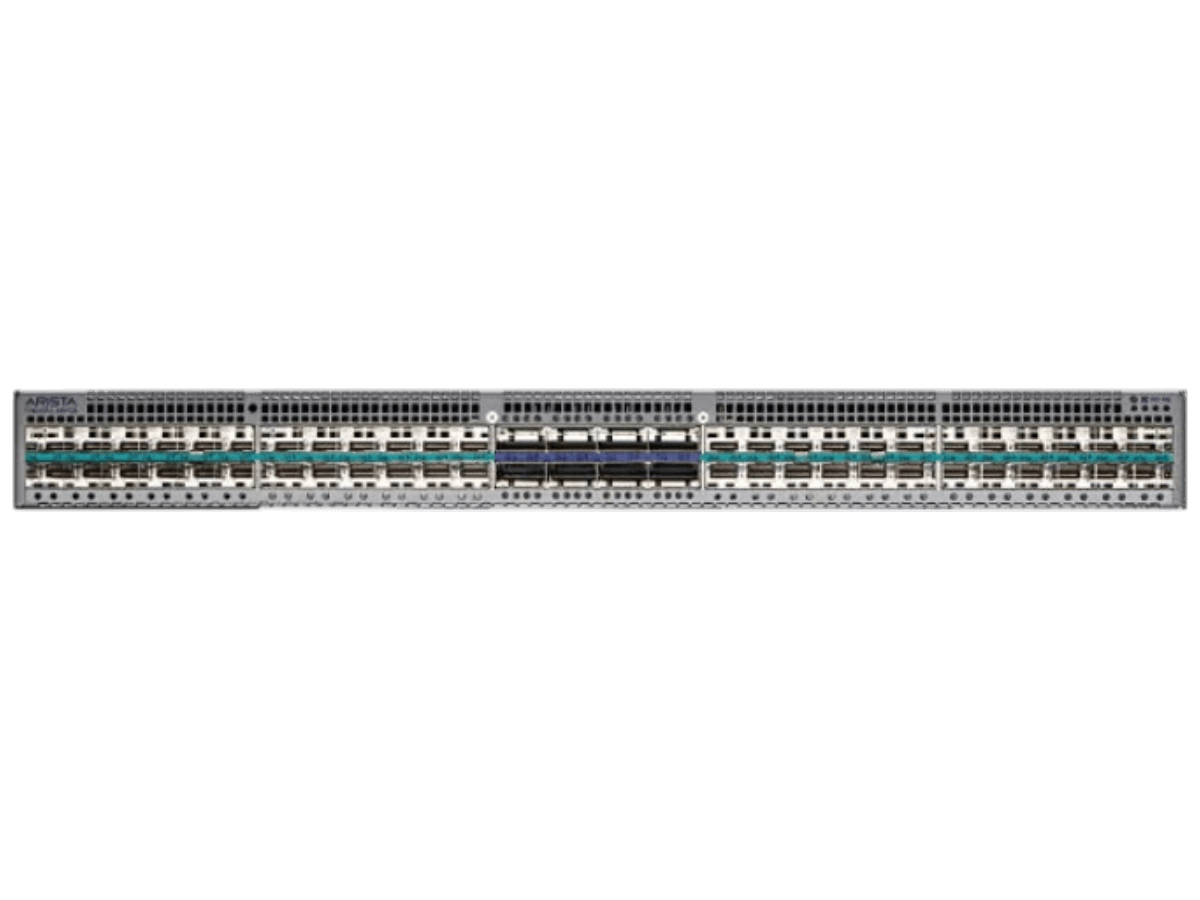
The Arista DCS-7280SR3-48YC8-F is a next-generation 1RU deep-buffer switch purpose-built for high-performance leaf, routing, and storage workloads in modern cloud, enterprise, and service-provider networks. Featuring 48 × SFP28 1/10/25GbE ports and 8 × QSFP28 40/100GbE uplinks, the 7280SR3-48YC8-F provides exceptional scale, lossless forwarding capability, and ultra-high performance based on the Broadcom Jericho2 architecture. The -F variant includes front-to-rear airflow, ideal for data center deployments with front-cold / rear-hot rack design.
As part of the broader Arista 7280 Series, the 7280SR3-48YC8-F delivers the density, telemetry, and routing performance required for large-scale cloud fabrics, VXLAN EVPN deployments, storage leafs, and high-touch service provider edge roles.
Key Features:
The 7280SR3-48YC8-F is engineered for environments requiring predictable forwarding under heavy fan-in and microburst conditions. Jericho2 deep buffers support:
The 8 × QSFP28 uplinks support 40GbE/100GbE as well as 4×10GbE or 4×25GbE breakout configurations.
Perfect for 25G leaf deployments feeding 100G spines.
Suitable for cloud routing, multi-tenant edge, and BGP-heavy designs.
Deep buffers deliver deterministic behavior under bursty storage I/O.
Ideal for mixed 10/25/40/100G aggregation layers.
Explore this guide to compare models, evaluate alternatives, and understand the full 7280R, 7280R2 and 7280R3 portfolio:
Compare this model with similar 25G/100G deep-buffer switches across the SR-family:
Arista DCS-7280SR3-48YC8-F
For help choosing the right SR/SR2/SR3 model, contact our team for expert guidance on leaf, routing, and storage designs.
Also available: DCS-7280SR3-48YC8-R with rear-to-front airflow.
Related Arista 7280 Series models: DCS-7280SR-48C6-R and DCS-7280SR-48C6-F.
1 x Seller Refurbished DCS-7280SR3-48YC8# chassis
2 x PWR-511AC-F Power Supplies
2 x FAN-7011M-F Fan Trays
1 x KIT-7101 Rackmount Kit
2 x AC Power Cords
1 x Console Cable
The Arista DCS-7280SR3-48YC8-F features 48 SFP28 ports that support 1G, 10G, and 25G Ethernet, along with 8 QSFP28 ports capable of 40G or 100G. The QSFP28 ports also support breakout into 4x10G or 4x25G, enabling up to 80 usable interfaces in a single 1U switch.
Yes, the DCS-7280SR3-48YC8-F supports a wide range of advanced Layer 2 and Layer 3 features, including MLAG, OSPF, BGP, IS-IS, EVPN, and VXLAN. These capabilities make it well-suited for both traditional and modern leaf-spine data center architectures.
Absolutely. The switch is engineered for modern data center fabric deployments, with native support for VXLAN and EVPN overlays. This allows it to efficiently support multi-tenant environments, workload mobility, and scalable virtualization strategies.
The DCS-7280SR3-48YC8-F provides a switching capacity of up to 2 Tbps, powered by the Jericho2C ASIC. This high throughput ensures non-blocking performance and consistent low latency, even under heavy load conditions.
Yes, the switch is built with reliability in mind. It includes redundant, hot-swappable power supplies and fans, advanced diagnostics, proactive telemetry, and support for high-availability configurations. These features help ensure continuous uptime in demanding data center environments.
The DCS-7280SR3-48YC8-F is a high-density, 1U switch delivering 2 Tbps throughput, ultra-low latency, and broad protocol support. It’s ideal for top-of-rack or spine roles in data centers requiring advanced automation, VXLAN/EVPN support, and flexible port configurations.
The switch delivers ultra-low latency starting at approximately 800 nanoseconds. Its optimized pipeline and buffer management minimize jitter, making it ideal for latency-sensitive workloads like financial trading and real-time analytics.
Yes, it supports IEEE 802.1AE MACsec encryption on both SFP28 and QSFP28 ports, providing hardware-based security for data in transit without compromising performance.
This switch is powered by the Broadcom Jericho2C ASIC, which supports 2 Tbps of switching capacity, deep buffer management, and advanced programmability features for scalable data center deployments.
The switch supports both front-to-rear and rear-to-front airflow options, ensuring compatibility with hot-aisle/cold-aisle data center cooling designs. This flexibility simplifies rack integration and thermal management.
Yes, it integrates natively with Arista CloudVision for centralized network-wide management, telemetry, configuration, and automation, supporting intent-based networking and DevOps workflows.
The primary difference is airflow direction. The DCS-7280SR3-48YC8-F uses front-to-rear airflow, while the DCS-7280SR3-48YC8-R uses rear-to-front. All other hardware and software capabilities are identical.
The DCS-7280CR3MK-32D4S-F offers fewer ports but includes deep buffer memory for congestion management. The DCS-7280SR3-48YC8-F focuses on higher port density and ultra-low latency, making it better suited for latency-sensitive environments.
The DCS-7280CR3-36S-F has 36 100G ports with larger buffers, ideal for high-throughput aggregation. The DCS-7280SR3-48YC8-F balances 1G–100G flexibility with low-latency switching, fitting top-of-rack deployments.
The DCS-7280SR3-40YC6 has fewer SFP28 and QSFP28 ports (40 and 6, respectively), offering slightly lower density than the 48YC8-F. Both share the same ASIC and software features, but the 48YC8-F provides more scalability.


