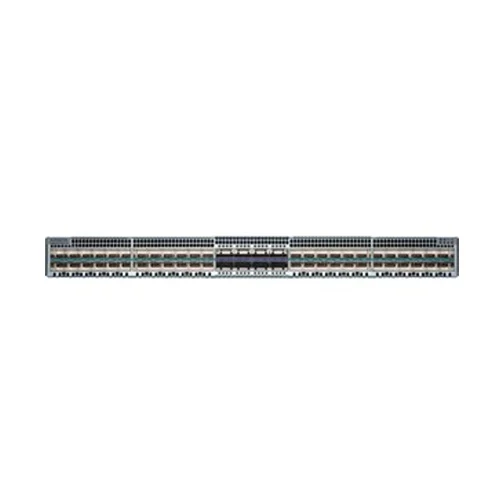
Arista DCS-7050SX3-48YC8C-F — High-Density 25G Leaf Switch with 16 GB RAM and Forward Airflow
The
Arista DCS-7050SX3-48YC8C-F is a 1RU, high-density data center leaf switch built on the 7050X3 platform. It delivers the same proven port layout as the 7050SX3 family — 48 × 25G SFP28 server-facing ports and 8 × 100G QSFP28 uplinks — with a key hardware upgrade over the standard 48YC8:
16 GB of system DRAM and
32 GB of flash storage. This expanded memory profile provides greater headroom for large routing tables, complex EVPN fabrics, richer EOS feature sets, and long-term EOS flexibility in demanding production environments. The “
-F” suffix denotes
front-to-rear (forward) airflow, where cool air enters from the non-port side of the switch and exhausts from the port side. This is the standard configuration for traditional
hot-aisle/cold-aisle data center designs and matches the airflow direction of most server platforms deployed in enterprise and colocation environments.
Key Features at a Glance
- 48 × 10G/25G SFP28 ports for high-density server and leaf connectivity
- 8 × 40G/100G QSFP28 uplinks supporting 4×25G / 4×10G breakout
- 1.28 Tbps non-blocking switching capacity and 1 Bpps forwarding rate
- Sub-microsecond latency (~800 ns) with low jitter for latency-sensitive workloads
- 16 GB system DRAM — double the 8 GB found on the standard 48YC8 — for larger tables and richer EOS feature sets
- 32 GB flash storage — 4× the 8 GB on the 48YC8 — for multiple EOS images, extended logs, and packet captures
- Minimum EOS 4.30.4 — access to the most current Arista feature sets and security patches
- Front-to-rear airflow (“-F”) for standard hot-aisle/cold-aisle data center deployments
- Redundant, hot-swappable power supplies and fan trays for continuous availability
- Full L2/L3 feature set including VXLAN, EVPN, MLAG, and advanced routing
- Rich telemetry stack: LANZ, sFlow, AEM, and streaming telemetry
- Runs Arista EOS® with open APIs, Python/Bash scripting, and CloudVision® integration
What the “C” Means: 16 GB DRAM, 32 GB Flash
The defining difference between the
DCS-7050SX3-48YC8C-F and the standard 48YC8-F is a hardware-level memory upgrade. Where the 48YC8 ships with 8 GB of system DRAM and 8 GB of flash storage, the 48YC8C doubles the RAM to
16 GB and quadruples the flash to
32 GB. This expanded resource pool has practical implications across several operational dimensions:
- Larger table capacity: More system memory supports larger MAC address tables, ARP/ND caches, and BGP/EVPN route tables — critical as fabrics scale to thousands of endpoints or multi-region routing policies
- Richer EOS feature sets: Memory-intensive EOS features — including advanced telemetry, complex policy maps, and multi-protocol stacks — run with greater headroom and stability
- Multiple EOS images on flash: 32 GB of storage allows you to stage upgrade images, maintain rollback versions, and store extended packet captures or debug logs without running out of space
- Future EOS headroom: The 48YC8C requires minimum EOS 4.30.4, giving access to current Arista releases and the feature roadmap well beyond what the older 4.24.0 baseline on the 48YC8 can support
All other hardware specifications — port count, throughput, latency, airflow options, power redundancy — are identical between the 48YC8 and 48YC8C. The “C” is purely a compute-tier upgrade within the same physical platform.
High-Throughput Architecture
Powered by a third-generation Broadcom Trident-based ASIC, the
DCS-7050SX3-48YC8C-F delivers
1.28 Tbps of non-blocking switching capacity and a forwarding rate of approximately
1 billion packets per second (1 Bpps). This architecture maintains consistent performance under heavy east-west traffic, ensuring deterministic behavior for mission-critical applications, large virtualized workloads, and high-throughput storage fabrics where predictable throughput is non-negotiable.
Ultra-Low Latency Switching
The
7050SX3-48YC8C-F delivers
sub-microsecond latency, typically around
800 nanoseconds, with low jitter across all ports. This makes it well suited for financial trading platforms, real-time analytics, and high-performance storage fabrics where microbursts and transient congestion must be controlled without compromising application response times.
Port Density and Flexible Configuration
The 48YC8C-F provides the same balanced port layout as the broader 7050SX3 family:
- 48 × SFP28 ports supporting 10GBASE and 25GBASE optics, DACs, and AOCs
- 8 × QSFP28 uplinks supporting native 40G/100G operation
- Breakout support for 4 × 25G or 4 × 10G per QSFP28 port
This layout supports a wide mix of legacy 10G servers and modern 25G infrastructure while providing enough uplink bandwidth to scale into 100G spine layers as fabrics grow.
Optics, Cables, and Interoperability
The
DCS-7050SX3-48YC8C-F supports a broad ecosystem of standards-based
optics and cables:
- SFP28: 10GBASE-SR/LR, 25GBASE-SR/LR, DACs, and AOCs
- QSFP28: 100GBASE-SR4/LR4/ER4, 40GBASE-SR4/LR4, and breakout cables (4×25G or 4×10G)
This flexibility lets you standardize on Arista-qualified or third-party optics while maintaining full interoperability across your leaf-spine fabric.
Modern Fabric Ready: VXLAN and EVPN Support
The
7050SX3-48YC8C-F is designed as a high-performance leaf switch for spine-leaf and cloud-scale architectures. It supports:
- VXLAN: Overlay networking for large Layer 2 domains and multi-tenant segmentation
- EVPN: Modern control plane for VXLAN overlays, MAC mobility, and efficient route distribution
- Up to 128-way ECMP: High-path diversity for leaf-spine fabrics with resilient east-west traffic engineering
- MLAG: Multi-chassis link aggregation for dual-homed server connectivity and redundant uplinks
The 48YC8C’s expanded 16 GB DRAM is particularly valuable for large-scale EVPN deployments, where MAC/IP binding tables and type-2/type-5 route counts can grow substantially across multi-site fabrics.
Telemetry, Monitoring, and Real-Time Insight
The
DCS-7050SX3-48YC8C-F includes Arista’s full telemetry stack for operational visibility:
- LANZ: Real-time microburst detection and queue depth visibility at the port level
- sFlow: Continuous traffic sampling for capacity planning and anomaly detection
- AEM (Arista Event Monitor): Programmable, rule-based alerting for system and traffic events
- Streaming Telemetry: High-frequency state export to analytics platforms and NMS tools
The 48YC8C’s additional DRAM provides more in-memory buffer for telemetry agents and event monitoring processes — useful in high-event-rate environments where telemetry data volume can compete with control plane memory on lower-spec platforms.
EOS Automation and Extensibility
Running on
Arista EOS®, the
DCS-7050SX3-48YC8C-F supports automation-centric operations at scale:
- Native on-box Python and Bash scripting via the Linux shell
- JSON-RPC eAPI for integration with Ansible, Terraform, Salt, and custom tooling
- CloudVision® for centralized configuration management, telemetry aggregation, and change control with full audit trail
- OpenConfig and gRPC for model-driven network management and streaming state export
The 48YC8C requires minimum
EOS 4.30.4, which means it runs on a modern, current-generation EOS baseline. Operators benefit from access to the full Arista feature roadmap, recent security patches, and newer capabilities unavailable on earlier EOS releases. The 32 GB flash also makes it practical to keep multiple EOS versions staged on-device for rapid rollback during upgrade cycles.
Front-to-Rear Airflow and Data Center Fit
The “
-F” airflow configuration provides
front-to-rear (forward) cooling, where cool air enters from the non-port (rear-facing) side of the switch and exhausts from the port (front-facing) side. This matches the airflow direction of the majority of rack-mounted servers and storage platforms and is the standard choice for:
- Traditional hot-aisle/cold-aisle containment deployments where cold air is supplied from the front of the rack
- Racks where the majority of installed compute and storage gear already uses front-to-rear airflow
- Colocation facilities that standardize on forward airflow for all customer equipment
- New data center builds following ASHRAE thermal guidelines for rack cooling
If your racks use
rear-to-front (reverse) airflow, consider the
DCS-7050SX3-48YC8C-R — identical in every respect except airflow direction.
Compliance and Sustainability
The Arista DCS-7050SX3-48YC8C-F aligns with modern environmental and safety standards:
- Secure boot with digitally signed EOS images to prevent unauthorized firmware
- RoHS and WEEE compliant — energy-efficient silicon contributes to lower power consumption per gigabit
- Compact 1RU form factor reduces data center footprint and cooling overhead
Security Features for Multi-Tenant Environments
Security is integrated at multiple layers of the platform:
- Secure boot and digitally signed EOS images
- Role-Based Access Control (RBAC) for granular administrative permissions
- TACACS+/RADIUS/LDAP for centralized authentication, authorization, and accounting
- Access Control Lists (ACLs) for enforcing micro-segmentation and traffic policy at wire speed
- Control Plane Policing (CoPP) to protect the switch CPU from volumetric attacks
Combined with VXLAN/EVPN overlay segmentation, these features support scalable multi-tenant isolation and secure segmentation across large fabrics.
Deployment Scenarios and Industry Applications
The
DCS-7050SX3-48YC8C-F is a strong fit for environments where scale, stability, and EOS longevity are priorities:
- Large-Scale EVPN Fabrics: The 16 GB DRAM provides headroom for MAC/IP tables that grow substantially in large multi-site EVPN deployments with many endpoints and VNIs.
- High Route-Count BGP Environments: Operators running full or partial internet routing tables, or complex multi-VRF enterprise policies, benefit from the additional memory available on the 48YC8C.
- Financial Services and Trading: Low-latency leaf switch for trading floors and market data distribution, with enough memory headroom to run complex policy maps and telemetry agents concurrently.
- Cloud and Hyperscale Data Centers: High-density leaf switch with 25G server access and 100G uplinks, suited for operators planning long deployment lifecycles and EOS upgrade cycles.
- Research and HPC Labs: High-bandwidth interconnect for AI/ML training, scientific simulation, and storage-heavy workloads where the expanded flash is useful for on-device packet capture and diagnostics.
- Enterprise Data Centers: A future-proof leaf option for organizations that want the flexibility to adopt newer EOS capabilities without a hardware refresh.
Lifecycle, Reliability, and Future-Proofing
Arista platforms like the
7050SX3-48YC8C-F are built for long operational lifecycles with high MTBF ratings and a consistent EOS release cadence. The 48YC8C’s expanded memory and modern EOS baseline (4.30.4+) make it better positioned than the standard 48YC8 for operators who anticipate continued growth in fabric scale, routing complexity, or feature density over the switch’s service life. Choosing the 48YC8C now avoids the need for a hardware refresh driven by memory or EOS constraints later.
Competitive Comparison
Compared to related platforms, the DCS-7050SX3-48YC8C-F offers a compelling combination of memory headroom, throughput, and EOS flexibility:
- Versus Arista DCS-7050SX3-48YC8-F: The 48YC8C-F provides double the system DRAM (16 GB vs 8 GB) and 4× the flash storage (32 GB vs 8 GB). Port count, throughput, and latency are identical. The 48YC8C is the right choice when scale, EOS headroom, or table capacity matters; the DCS-7050SX3-48YC8-F remains a strong value option for smaller deployments.
- Versus Cisco Nexus 93180YC-FX3: Comparable 25G/100G port layout with a more open, automation-friendly EOS environment and richer streaming telemetry integration.
- Versus Juniper QFX5120-48Y: Comparable 25G/100G port layout; the 48YC8C-F differentiates on EOS automation depth, native CloudVision integration, and expanded on-box memory for large-scale EVPN environments.
Similar Arista 7050SX3 Models to Consider
If you’re evaluating the
Arista DCS-7050SX3-48YC8C-F, the following models offer closely related capabilities:
- Arista DCS-7050SX3-48YC8C-R – Identical to this model (16 GB DRAM, 32 GB flash) but with rear-to-front (reverse) airflow, ideal for racks with reverse thermal design or lab environments.
- Arista DCS-7050SX3-48YC8-F – Same port layout and forward airflow with 8 GB DRAM and 8 GB flash. The right choice when large table capacity and extended EOS headroom are not required.
- Arista DCS-7050SX3-48YC12-F – Same 48×25G access design with 12 × 100G uplinks for fabrics requiring higher spine-facing bandwidth density.
- Arista DCS-7060CX-32S-F – 32×100G spine platform to pair with 48YC8C leaf switches in a full 25G/100G leaf-spine fabric.
Related 7050SX3 Resources
To explore the full Arista 7050SX3 portfolio and understand how the DCS-7050SX3-48YC8C-F fits into your design:
Arista 7050SX3 Switches: Your Go-To Guide & Battle Card Breakdown
The High-Memory Leaf Switch for Scale-First Data Centers
The
Arista DCS-7050SX3-48YC8C-F delivers everything the standard 7050SX3 is known for — dense 25G access, flexible 100G uplinks, sub-microsecond latency, and EOS automation — with a critical hardware upgrade:
16 GB of system DRAM and 32 GB of flash storage. That memory advantage translates directly into larger routing tables, more complex EOS feature sets, and a longer service life without memory-constrained hardware refreshes. Its front-to-rear airflow makes it the natural fit for standard hot-aisle/cold-aisle deployments, and its minimum EOS 4.30.4 baseline ensures access to Arista’s current feature roadmap from day one. Available from BrightStar Systems fully tested, reset to factory defaults, and backed by a 5-year in-house warranty.