
90 Day Resell / 1 Year User
Worldwide Shipping
Mon-Fri / 8am – 5 pm PST
8 in stock
What happens after requesting a quote:


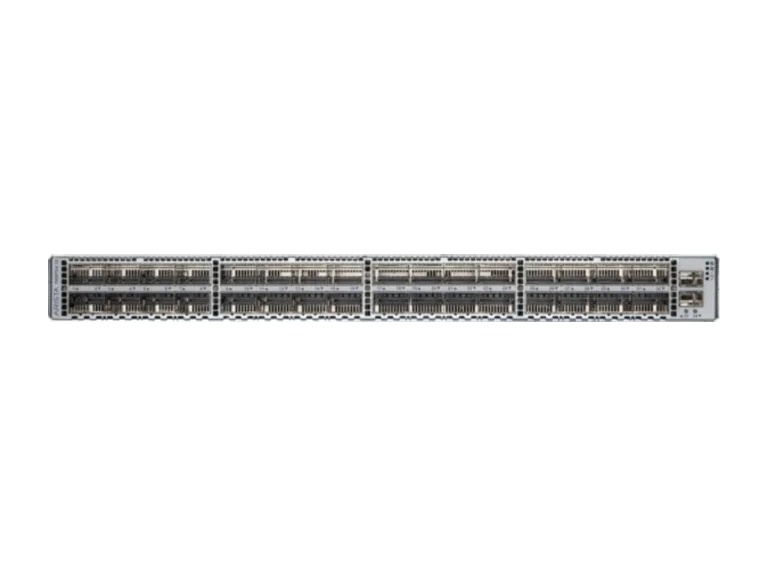
The Arista DCS-7060CX-32S-F is a 1RU, 32-port 100G spine switch built on the first-generation 7060X platform. Delivering 6.4 Tbps of non-blocking switching capacity, 450 ns cut-through latency, and a 16 MB shared packet buffer, it is a proven spine-layer platform for high-density 25G/100G leaf-spine fabrics in cloud-scale data centers, financial trading infrastructure, HPC clusters, and large enterprise environments. The 7060CX-32S represents the foundation of Arista’s 32-port 100G spine portfolio — a mature, widely deployed platform with an established record in production data centers worldwide. The “-F” suffix denotes front-to-rear (forward) airflow, the standard configuration for traditional hot-aisle/cold-aisle data center designs where cold air is supplied from the front of the rack.
The 7060CX-32S is built on Broadcom’s Tomahawk ASIC (BCM56960), the silicon that established the 100G data center switching standard and powers a significant share of production spine deployments globally. This platform heritage matters: Broadcom Tomahawk silicon has been extensively production-validated across hyperscale, financial, and enterprise environments, with the full depth of EOS feature development concentrated on this architecture over years of active deployment. For architects choosing between the 7060CX-32S and the next-generation 7060CX2-32S: both platforms deliver identical 6.4 Tbps throughput and 450 ns latency. The 7060CX-32S offers a proven, cost-effective spine option for deployments where the CX2’s additional 22 MB buffer (vs 16 MB here) is not a deciding factor. The 7060CX is particularly well suited for fabrics where traffic patterns are predictable and congestion management needs are well-understood.
The DCS-7060CX-32S-F delivers 6.4 Tbps of full-duplex, non-blocking switching capacity across all 32 QSFP28 ports. Every port operates simultaneously at 100G line rate without oversubscription — the fundamental requirement for spine switches where east-west bandwidth is the primary architectural constraint. This throughput ceiling holds consistently regardless of traffic mix, packet size distribution, or active flow count, providing the predictable performance that production leaf-spine fabrics require.
In cut-through switching mode, the 7060CX-32S-F delivers 450 nanoseconds of port-to-port latency with consistent, low jitter across all 32 ports. This sub-microsecond performance makes it suitable for high-frequency trading platforms, real-time analytics pipelines, and distributed financial processing systems where spine-layer latency directly impacts application performance and round-trip times across the fabric.
The 7060CX-32S provides 32 × QSFP28 ports, each configurable at five different speeds:
The 16 MB shared buffer pool is dynamically allocated across all ports, concentrating available buffer depth on whichever ports experience congestion at any given moment — a more efficient approach than fixed per-port buffer allocation.
The DCS-7060CX-32S-F supports a broad ecosystem of standards-based optics and cables:
The 7060CX-32S-F is purpose-built for the spine layer of modern leaf-spine architectures:
The DCS-7060CX-32S-F includes Arista’s full telemetry stack:
Running on Arista EOS®, the DCS-7060CX-32S-F is built for automation-first network operations:
The “-F” airflow configuration provides front-to-rear (forward) cooling, where cool air enters from the non-port side of the switch and exhausts from the port side. This is the standard configuration for:
If your racks use rear-to-front (reverse) airflow, consider the DCS-7060CX-32S-R — identical in every respect except airflow direction.
The 7060CX-32S-F is built for long operational lifecycles with high MTBF ratings, field-replaceable fans and power supplies, and full EOS support. Its Broadcom Tomahawk ASIC is one of the most widely deployed and thoroughly tested data center switching platforms in the industry, providing operators confidence in long-term software support, vendor interoperability, and operational familiarity across large switch fleets.
Arista 7060 Series Switches: Architecture, Models, and Deployment Guide
The Arista DCS-7060CX-32S-F brings together 6.4 Tbps of non-blocking capacity, 450 ns cut-through latency, 32-port 100G density, and the proven Broadcom Tomahawk platform into a mature, production-validated 1RU spine switch. Its front-to-rear airflow makes it the standard choice for hot-aisle/cold-aisle data centers, and its full EOS feature set — from VXLAN/EVPN to LANZ telemetry and CloudVision automation — makes it ready to support any modern data center architecture. Available from BrightStar Systems fully tested, reset to factory defaults, and backed by a 1-year in-house warranty.
| Milestone | Date |
|---|---|
| End of Sale announcement | July 1, 2026 |
| Last day to order from Arista | October 1, 2026 (subject to availability) |
| Last day to add a service contract / request hardware failure analysis | October 1, 2027 |
| Last day for software bug fixes and support | October 1, 2029 |
| Last day to renew an existing service contract | October 1, 2030 |
| End of life (last day for TAC support and hardware RMA) | October 1, 2031 |
Arista’s named replacement for the DCS-7060CX-32S is the DCS-7050CX3-32C.
BrightStar Systems continues to supply the DCS-7060CX-32S-F refurbished after Arista’s last order date, tested and covered by our 1-year in-house warranty, and stocks the DCS-7050CX3-32C for customers migrating. Lifecycle dates checked against Arista’s End of Sale notice 24132 on September 25, 2026; see our Arista end-of-life list for every affected model.
Q: What are the key benefits of the Arista DCS-7060CX-32S-F?
A. This switch delivers high-density 100GbE connectivity, low latency, and high throughput, making it perfect for cloud and high-performance data center environments.
Q: Does it support front-to-back airflow?
A. Yes, the DCS-7060CX-32S-F has a front-to-back airflow design for efficient cooling in data center racks.
Q: What operating system does the switch run on?
A. It uses Arista’s EOS platform, which offers advanced automation, programmability, and real-time telemetry.
Q: Can the power supplies be replaced without interrupting the network?
A. Yes, the DCS-7060CX-32S-F features hot-swappable, dual redundant power supplies for continuous operation.