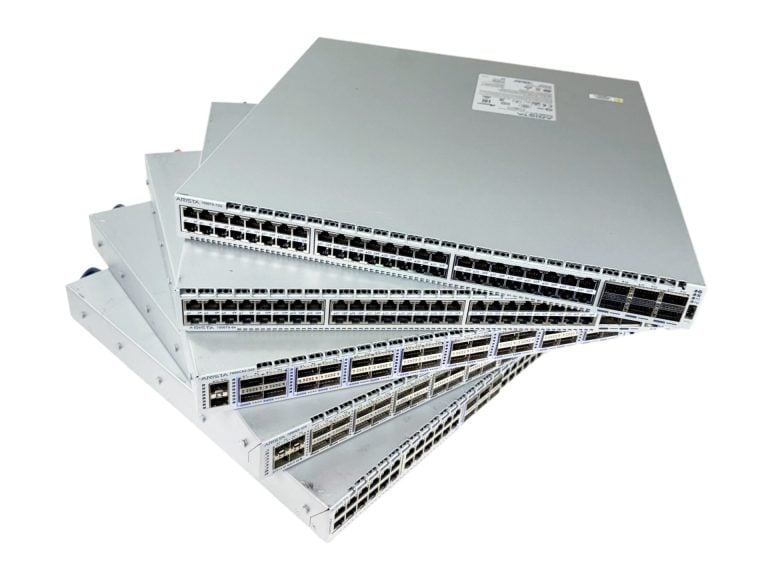
Arista DCS-7060CX2-32S-F — 32×100G Spine Switch with Deeper Buffer and Forward Airflow
The Arista DCS-7060CX2-32S-F is a 1RU, 32-port 100G spine switch built on the 7060X2 platform. Delivering 6.4 Tbps of non-blocking switching capacity with 450 ns cut-through latency and a 22 MB shared packet buffer, it is purpose-built for the spine layer of high-density 25G/100G leaf-spine fabrics. The CX2 adds a 40% deeper packet buffer and native IEEE 802.3by 25GbE support over the first-generation 7060CX-32S, making it the right choice for environments where bursty traffic patterns demand more headroom for congestion management. The “-F” suffix denotes front-to-rear (forward) airflow, the standard configuration for traditional hot-aisle/cold-aisle data center designs where cold air is supplied from the front of the rack.
Key Features at a Glance
- 32 × 100GbE QSFP28 ports with 5-speed flexibility: 100G, 40G, 4×25G, 4×10G, or 2×50G per port
- 6.4 Tbps non-blocking switching capacity — full wire speed across all 32 ports simultaneously
- 450 ns cut-through latency for latency-sensitive workloads including HFT and real-time analytics
- 22 MB shared packet buffer — 40% deeper than the 7060CX-32S (16 MB) for superior congestion absorption
- Native IEEE 802.3by 25GbE support — direct 25G connectivity without compatibility adaptations
- Front-to-rear airflow (“-F”) for standard hot-aisle/cold-aisle data center deployments
- Redundant, hot-swappable power supplies and fan trays for continuous high availability
- Full L2/L3 feature set: VXLAN, EVPN, MLAG, ECMP, BGP, and advanced routing
- Rich telemetry: LANZ, sFlow, AEM, and streaming telemetry
- Runs Arista EOS® with open APIs, Python/Bash scripting, and CloudVision® integration
The CX2 Upgrade: 40% Deeper Buffer and Native 25GbE
The 7060CX2-32S preserves every performance characteristic of the original 7060CX-32S — 32×100G ports, 6.4 Tbps throughput, 450 ns latency — while delivering two meaningful upgrades in its next-generation ASIC:
- 22 MB shared packet buffer vs 16 MB on the CX: A 40% increase in shared buffer depth gives the CX2 substantially more room to absorb incast events, bursty storage traffic, and east-west congestion without dropping packets or triggering back-pressure. In spine roles where many-to-one traffic converges at line rate, this buffer headroom directly translates into lower tail latency and fewer retransmits under load.
- Native IEEE 802.3by 25GbE support: The CX2 natively supports the 25GbE standard across all 32 QSFP28 ports, ensuring clean interoperability with 25G leaf switches and servers without requiring backward-compatibility workarounds. This matters in environments mixing Arista 7050SX3 leaf switches, 25G servers, and 100G uplinks in a single fabric.
All other hardware — port count, form factor, throughput ceiling, and EOS feature set — is identical between the CX and CX2. The CX2 is the logical upgrade for fabric architects who want the same proven 7060X platform with more congestion management headroom.
6.4 Tbps Non-Blocking Architecture
The DCS-7060CX2-32S-F delivers 6.4 Tbps of full-duplex, non-blocking switching capacity across all 32 QSFP28 ports. Every port operates simultaneously at 100G line rate without oversubscription — the fundamental requirement for spine switches where east-west bandwidth is the primary architectural constraint. This throughput ceiling holds consistently regardless of traffic mix, packet size distribution, or active flow count, providing the predictable performance that production leaf-spine fabrics require.
450 ns Cut-Through Latency
Operating in cut-through switching mode, the 7060CX2-32S-F delivers 450 nanoseconds of port-to-port latency with low jitter across all 32 ports. This sub-microsecond performance makes it suitable for high-frequency trading platforms, real-time analytics pipelines, and distributed financial processing systems where spine-layer latency directly impacts application performance and round-trip times across the fabric.
Port Density and 5-Speed Flexibility
The 7060CX2-32S provides 32 × QSFP28 ports, each configurable at five different speeds:
- 100GbE — native full-rate for spine-to-spine or spine-to-DCI connections
- 40GbE — backward compatibility with existing 40G infrastructure
- 4 × 25GbE breakout — connect up to 128 leaf switches from a single 1RU spine
- 4 × 10GbE breakout — legacy 10G endpoint or switch connectivity
- 2 × 50GbE breakout — dual 50G connectivity for bonded NICs or storage nodes
This per-port flexibility allows a single 7060CX2-32S spine to simultaneously service leaf switches at 100G, connect to legacy 40G aggregation, and provide breakout connectivity to 25G endpoints — without any additional hardware.
Optics, Cables, and Interoperability
The DCS-7060CX2-32S-F supports a broad ecosystem of standards-based optics and cables:
- 100G QSFP28: 100GBASE-SR4, LR4, ER4, PSM4; QSFP28 DACs and AOCs for short-reach spine-to-leaf connections
- 40G QSFP+: 40GBASE-SR4, LR4; QSFP+ DACs for backward-compatible uplinks
- Breakout cables: MPO-to-LC fan-out cables for 4×25G or 4×10G configurations
Spine-Optimized Fabric Support: VXLAN, EVPN, and ECMP
The 7060CX2-32S-F is designed as a high-performance spine switch for modern leaf-spine and cloud-scale architectures:
- VXLAN: Spine-layer VXLAN routing for scalable overlay fabrics with large VNI counts
- EVPN: BGP-based control plane for distributed MAC/IP learning, multi-tenancy, and MAC mobility
- Up to 128-way ECMP: Maximum path diversity across the spine layer, distributing east-west load evenly across all leaf uplinks
- BGP and IS-IS: Full-featured underlay routing for IP fabric and routed-spine topologies
The 7060CX2’s expanded 22 MB buffer is particularly valuable on the spine when multiple leaf switches simultaneously burst toward the same destination — a common pattern in storage, AI training, and analytics workloads where many-to-one traffic converges through a small number of spine uplinks.
Telemetry, Monitoring, and Real-Time Insight
The DCS-7060CX2-32S-F includes Arista’s full telemetry stack for spine-layer observability:
- LANZ (Latency Analyzer): Per-port, real-time queue depth visibility and microburst detection — essential for diagnosing congestion events at the spine without impacting production traffic
- sFlow: Continuous traffic sampling for east-west flow analysis, elephant flow detection, and capacity planning
- AEM (Arista Event Monitor): Rule-based, programmable alerting for link events, queue thresholds, and routing protocol state changes
- Streaming Telemetry: High-frequency counter and state export to gRPC collectors, Grafana, Prometheus, and third-party NMS tools
EOS Automation and Extensibility
Running on Arista EOS®, the DCS-7060CX2-32S-F is built for automation-first network operations:
- Native on-box Python and Bash scripting via the Linux shell
- JSON-RPC eAPI for programmatic configuration — integrates with Ansible, Terraform, Salt, and Nornir
- CloudVision® for centralized configuration management, zero-touch provisioning, and change control
- OpenConfig and gNMI/gRPC for model-driven management and streaming state export
- Zero-Touch Provisioning (ZTP) for fully automated day-0 configuration of new spine switches
Front-to-Rear Airflow and Data Center Fit
The “-F” airflow configuration provides front-to-rear (forward) cooling, where cool air enters from the non-port side of the switch and exhausts from the port side. This is the standard configuration for:
- Traditional hot-aisle/cold-aisle containment deployments where cold air is supplied from the front of the rack
- Racks where the majority of compute and network gear already uses front-to-rear airflow
- Colocation facilities that standardize on forward airflow for all customer equipment
- New data center builds following ASHRAE thermal guidelines
If your racks use rear-to-front (reverse) airflow, consider the DCS-7060CX2-32S-R — identical in every respect except airflow direction.
Compliance and Sustainability
- RoHS and WEEE compliant — energy-efficient ASIC design contributes to lower power per gigabit
- Secure boot with digitally signed EOS images to prevent unauthorized firmware modifications
- Compact 1RU form factor maximizes port density per rack unit in spine aggregation rows
Security Features
- Secure boot and digitally signed EOS images
- Role-Based Access Control (RBAC) for granular operator and administrator separation
- TACACS+/RADIUS/LDAP for centralized authentication and accounting
- ACLs for traffic policy and spine-layer segmentation enforcement
- Control Plane Policing (CoPP) to protect the switch CPU from volumetric attacks
Deployment Scenarios and Industry Applications
- 25G/100G Leaf-Spine Fabrics: The natural spine pairing for Arista 7050SX3-series leaf switches — 32×100G uplinks with 22 MB buffer to absorb east-west incast without fabric degradation.
- High-Frequency Trading Infrastructure: Sub-500 ns cut-through latency for trading floor core switching and inter-pod connectivity.
- Hyperscale and Cloud Data Centers: 6.4 Tbps non-blocking capacity with 128-way ECMP for full-bisection-bandwidth fabric designs.
- HPC and AI/ML Clusters: The deeper 22 MB buffer handles bursty all-to-all communication patterns in MPI workloads and AI training jobs where incast is frequent.
- Large Enterprise Data Centers: Spine layer for multi-pod enterprise deployments needing 100G spine connectivity and proven EOS feature depth.
- Colocation Providers: Per-port 5-speed flexibility lets the same physical spine connect 100G, 40G, and breakout 25G/10G tenants simultaneously.
Lifecycle, Reliability, and Future-Proofing
The 7060CX2-32S-F is built for long operational lifecycles with high MTBF ratings, field-replaceable fans and power supplies, and a consistent Arista EOS release cadence. Its deeper buffer and native 25GbE support position it well for fabrics that continue to expand leaf-switch density and 25G server deployments over a multi-year horizon.
Competitive Comparison
- Versus Arista DCS-7060CX-32S-F: The CX2-32S-F adds 40% deeper buffer (22 MB vs 16 MB) and native 25GbE support. For bursty east-west workloads, the CX2 provides more congestion headroom; the DCS-7060CX-32S-F offers proven value where the additional buffer is not a deciding factor.
- Versus Cisco Nexus 9332C: Comparable 32×100G spine; the 7060CX2 differentiates on lower latency, LANZ buffer visibility, and EOS automation ecosystem.
- Versus Juniper QFX5200-32C: Similar port density and throughput; the 7060CX2-32S-F differentiates on EOS automation depth and native CloudVision integration.
Similar Arista 7060 Models to Consider
- Arista DCS-7060CX2-32S-R – Identical to this model but with rear-to-front (reverse) airflow, ideal for reverse-cooled racks and labs.
- Arista DCS-7060CX-32S-F – First-generation 7060CX spine with 16 MB buffer, same port count and throughput. The value option when 22 MB buffer depth is not required.
- Arista DCS-7280CR3-32D4-F – 32×100G + 4×400G switch router with 8 GB buffer and full MPLS/SR routing for DCI-edge deployments.
- Arista DCS-7050SX3-48YC8-F – 48×25G + 8×100G leaf switch, the natural leaf pairing for 7060CX2-32S-F spine deployments.
Related 7060X Resources
Arista 7060 Series Switches: Architecture, Models, and Deployment Guide
The Spine Switch Built for Bursty, High-Density 100G Fabrics
The Arista DCS-7060CX2-32S-F delivers everything demanded of a modern data center spine — 6.4 Tbps of non-blocking capacity, 450 ns cut-through latency, 32-port 100G density, and the full depth of Arista EOS automation — with a 40% deeper packet buffer and native 25GbE support that give it a practical edge in bursty, mixed-speed environments. Its front-to-rear airflow makes it the natural choice for standard hot-aisle/cold-aisle deployments. Available from BrightStar Systems fully tested, reset to factory defaults, and backed by a 5-year in-house warranty.
Lifecycle Status: DCS-7060CX2-32S (Arista End of Sale Notice 24132)
| Milestone | Date |
|---|
| End of Sale announcement | July 1, 2026 |
| Last day to order from Arista | October 1, 2026 (subject to availability) |
| Last day to add a service contract / request hardware failure analysis | October 1, 2027 |
| Last day for software bug fixes and support | October 1, 2029 |
| Last day to renew an existing service contract | October 1, 2030 |
| End of life (last day for TAC support and hardware RMA) | October 1, 2031 |
Arista’s named replacement for the DCS-7060CX2-32S is the DCS-7050CX3-32C.
BrightStar Systems continues to supply the DCS-7060CX2-32S-F refurbished after Arista’s last order date, tested and covered by our 5-year in-house warranty, and stocks the DCS-7050CX3-32C for customers migrating. Lifecycle dates checked against Arista’s End of Sale notice 24132 on September 25, 2026; see our Arista end-of-life list for every affected model.