
5 Years End User / 90 Days Resell
Worldwide Shipping
Mon-Fri / 8am – 5 pm PST
22 in stock
What happens after requesting a quote:


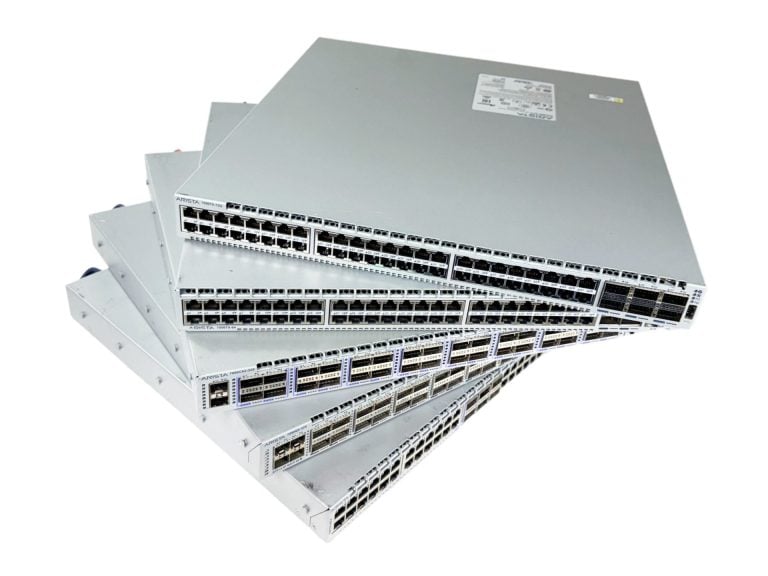
The Arista DCS-7060CX2-32S-R is a 1RU, 32-port 100G spine switch built on the 7060X2 platform. Delivering 6.4 Tbps of non-blocking switching capacity with 450 ns cut-through latency and a 22 MB shared packet buffer, it is purpose-built for the spine layer of high-density 25G/100G leaf-spine fabrics. The CX2 adds a 40% deeper packet buffer and native IEEE 802.3by 25GbE support over the first-generation 7060CX-32S, making it the right choice for environments where bursty traffic patterns demand more headroom for congestion management. The “-R” suffix denotes rear-to-front (reverse) airflow, making this model ideal for data centers, labs, and mixed-equipment racks that standardize on reverse thermal design.
The 7060CX2-32S preserves every performance characteristic of the original 7060CX-32S — 32×100G ports, 6.4 Tbps throughput, 450 ns latency — while delivering two meaningful upgrades in its next-generation ASIC:
All other hardware — port count, form factor, throughput ceiling, and EOS feature set — is identical between the CX and CX2. The CX2 is the logical upgrade for fabric architects who want the same proven 7060X platform with more congestion management headroom.
The DCS-7060CX2-32S-R delivers 6.4 Tbps of full-duplex, non-blocking switching capacity across all 32 QSFP28 ports. This means every port can transmit and receive at 100G simultaneously without any oversubscription — critical for spine switches where east-west bandwidth is the primary bottleneck. The platform maintains this throughput ceiling regardless of traffic mix, packet size distribution, or the number of active flows, providing the predictable spine performance that large-scale fabrics depend on.
Operating in cut-through switching mode, the 7060CX2-32S-R delivers 450 nanoseconds of port-to-port latency with low jitter across all 32 ports. This places it firmly in the sub-microsecond tier required by latency-sensitive applications including high-frequency trading systems, real-time analytics pipelines, and distributed financial processing infrastructure. At 450 ns, the switch contributes minimal latency to the overall fabric round-trip time even in multi-hop topologies.
The 7060CX2-32S provides 32 × QSFP28 ports, each configurable at five different speeds:
This per-port flexibility allows a single 7060CX2-32S spine to simultaneously service leaf switches at 100G, connect to legacy 40G aggregation, and provide breakout connectivity to 25G endpoints — without any additional hardware.
The DCS-7060CX2-32S-R supports a broad ecosystem of standards-based optics and cables across all 32 QSFP28 ports:
Standards-based QSFP28 interoperability ensures you can source optics and cables from Arista-qualified vendors or third-party suppliers while maintaining full switch functionality.
The 7060CX2-32S-R is designed from the ground up as a high-performance spine switch for modern leaf-spine and cloud-scale architectures:
With 32 downlinks running at 100G, the 7060CX2-32S can serve as the spine layer for a leaf-spine fabric supporting up to 32 leaf switches, each with 100G uplinks — providing a fully non-blocking path for 3,200+ server-facing ports in a single-tier spine.
The DCS-7060CX2-32S-R includes Arista’s full telemetry stack for spine-layer observability:
LANZ is particularly valuable in spine roles, where many-to-one incast patterns can create transient queue buildup on a small number of downlinks. Real-time buffer visibility lets operators identify and remediate hot spots before they degrade fabric performance.
Running on Arista EOS®, the DCS-7060CX2-32S-R is built for automation-first network operations:
EOS’s single-binary image and stateful restart architecture simplify upgrade cycles across large spine fleets, with in-service software upgrades (ISSU) where supported to minimize planned maintenance windows.
The “-R” airflow configuration provides rear-to-front (reverse) cooling, ideal for:
The switch includes variable-speed fans and redundant, hot-swappable power supplies to balance thermal efficiency with uptime requirements. If your racks use front-to-rear (forward) airflow, consider the DCS-7060CX2-32S-F — identical in every respect except airflow direction.
The Arista DCS-7060CX2-32S-R aligns with modern environmental and safety standards:
Security is integrated at the platform and software level:
The DCS-7060CX2-32S-R is optimized for high-performance spine roles across a range of deployment types:
The 7060CX2-32S-R is built for long operational lifecycles with high MTBF ratings, field-replaceable fans and power supplies, and a consistent Arista EOS release cadence. Its deeper buffer and native 25GbE support position it well for fabrics that continue to expand leaf-switch density and server 25G deployments over a multi-year horizon. The 7060CX2 is a widely deployed platform with an established track record in production data centers globally.
Compared to related spine platforms, the DCS-7060CX2-32S-R delivers a strong combination of throughput, latency, and buffer management:
If you’re evaluating the Arista DCS-7060CX2-32S-R, these closely related models are worth comparing:
To explore the broader Arista 7060X portfolio and understand how the DCS-7060CX2-32S-R fits into a complete leaf-spine design: Arista 7060 Series Switches: Architecture, Models, and Deployment Guide
The Arista DCS-7060CX2-32S-R delivers everything demanded of a modern data center spine — 6.4 Tbps of non-blocking capacity, 450 ns cut-through latency, 32-port 100G density, and the full depth of Arista EOS automation — with a 40% deeper packet buffer and native 25GbE support that give it a practical edge in bursty, mixed-speed environments. Its rear-to-front airflow makes it the right choice for reverse-cooled data centers and labs. Available from BrightStar Systems fully tested, reset to factory defaults, and backed by a 5-year in-house warranty.
| Milestone | Date |
|---|---|
| End of Sale announcement | July 1, 2026 |
| Last day to order from Arista | October 1, 2026 (subject to availability) |
| Last day to add a service contract / request hardware failure analysis | October 1, 2027 |
| Last day for software bug fixes and support | October 1, 2029 |
| Last day to renew an existing service contract | October 1, 2030 |
| End of life (last day for TAC support and hardware RMA) | October 1, 2031 |
Arista’s named replacement for the DCS-7060CX2-32S is the DCS-7050CX3-32C.
BrightStar Systems continues to supply the DCS-7060CX2-32S-R refurbished after Arista’s last order date, tested and covered by our 5-year in-house warranty, and stocks the DCS-7050CX3-32C for customers migrating. Lifecycle dates checked against Arista’s End of Sale notice 24132 on September 25, 2026; see our Arista end-of-life list for every affected model.
The Arista DCS-7060CX2-32S-R sets itself apart with its versatile port options, supporting a wide range of speeds from 10G to 100G, catering to diverse networking needs.
The rear-to-front airflow design of the Arista DCS-7060CX2-32S-R ensures efficient cooling, maintaining optimal operating temperatures and prolonging the lifespan of critical components.
Absolutely. The modular design of the Arista DCS-7060CX2-32S-R allows for seamless scalability, ensuring that your network infrastructure can grow alongside your business.
Yes, the Arista DCS-7060CX2-32S-R comes equipped with remote management capabilities, allowing for easy configuration and monitoring of network operations.