
5 Years End User / 90 Days Resell
Worldwide Shipping
Mon-Fri / 8am – 5 pm PST
2 in stock
What happens after requesting a quote:


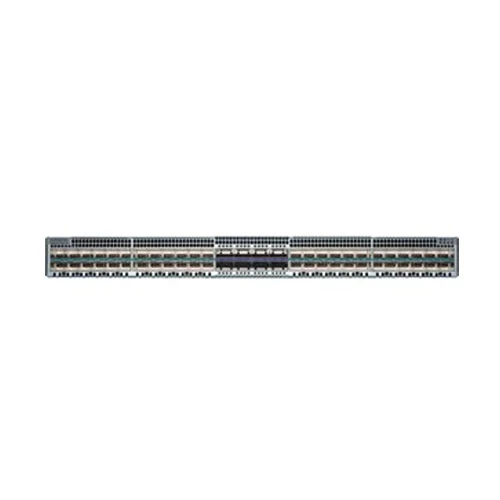
The Arista DCS-7050SX3-48YC8C-R is a 1RU, high-density data center leaf switch built on the 7050X3 platform. It delivers the same proven port layout as the 7050SX3 family — 48 × 25G SFP28 server-facing ports and 8 × 100G QSFP28 uplinks — with a key hardware upgrade over the standard 48YC8: 16 GB of system DRAM and 32 GB of flash storage. This expanded memory profile provides greater headroom for large routing tables, complex EVPN fabrics, richer EOS feature sets, and long-term EOS flexibility in demanding production environments. The “-R” suffix denotes rear-to-front (reverse) airflow, making this model ideal for data centers, labs, and mixed-equipment racks that standardize on reverse thermal design — where cool air enters from the rear of the rack and hot air exits from the front.
The defining difference between the DCS-7050SX3-48YC8C-R and the standard 48YC8-R is a hardware-level memory upgrade. Where the 48YC8 ships with 8 GB of system DRAM and 8 GB of flash storage, the 48YC8C doubles the RAM to 16 GB and quadruples the flash to 32 GB. This expanded resource pool has practical implications across several operational dimensions:
All other hardware specifications — port count, throughput, latency, airflow options, power redundancy — are identical between the 48YC8 and 48YC8C. The “C” is purely a compute-tier upgrade within the same physical platform.
Powered by a third-generation Broadcom Trident-based ASIC, the DCS-7050SX3-48YC8C-R delivers 2 Tbps (4 Tbps full duplex) of non-blocking switching capacity and a forwarding rate of approximately 1 billion packets per second (1 Bpps). This architecture maintains consistent performance under heavy east-west traffic, ensuring deterministic behavior for mission-critical applications and large-scale virtualized workloads.
The 7050SX3-48YC8C-R delivers sub-microsecond latency, typically around 800 nanoseconds, with low jitter across all ports. This makes it well suited for financial trading platforms, real-time analytics, and high-performance storage fabrics where microbursts and transient congestion must be controlled without compromising application response times.
The 48YC8C-R provides the same balanced port layout as the broader 7050SX3 family:
This layout supports a wide mix of legacy 10G servers and modern 25G infrastructure while providing enough uplink bandwidth to scale into 100G spine layers as fabrics grow.
The DCS-7050SX3-48YC8C-R supports a broad ecosystem of standards-based optics and cables:
This flexibility lets you standardize on Arista-qualified or third-party optics while maintaining full interoperability across your leaf-spine fabric.
The 7050SX3-48YC8C-R is designed as a high-performance leaf switch for spine-leaf and cloud-scale architectures. It supports:
The 48YC8C’s expanded 16 GB DRAM is particularly valuable for large-scale EVPN deployments, where MAC/IP binding tables and type-2/type-5 route counts can grow substantially across multi-site fabrics.
The DCS-7050SX3-48YC8C-R includes Arista’s full telemetry stack for operational visibility:
The 48YC8C’s additional DRAM provides more in-memory buffer for telemetry agents and event monitoring processes — useful in high-event-rate environments where telemetry data volume can compete with control plane memory on lower-spec platforms.
Running on Arista EOS®, the DCS-7050SX3-48YC8C-R supports automation-centric operations at scale:
The 48YC8C requires minimum EOS 4.30.1, which means it runs on a modern, current-generation EOS baseline. Operators benefit from access to the full Arista feature roadmap, recent security patches, and newer capabilities unavailable on earlier EOS releases. The 32 GB flash also makes it practical to keep multiple EOS versions staged on-device for rapid rollback during upgrade cycles.
The “-R” airflow configuration provides rear-to-front (reverse) cooling, ideal for:
The switch also includes variable-speed fans and redundant, hot-swappable power supplies to balance efficiency with uptime requirements. If your racks use front-to-rear (forward) airflow, consider the DCS-7050SX3-48YC8C-F — identical in every respect except airflow direction.
The Arista DCS-7050SX3-48YC8C-R aligns with modern environmental and safety standards:
Security is integrated at multiple layers of the platform:
Combined with VXLAN/EVPN overlay segmentation, these features support scalable multi-tenant isolation and secure segmentation across large fabrics.
The DCS-7050SX3-48YC8C-R is a strong fit for environments where scale, stability, and EOS longevity are priorities:
Arista platforms like the 7050SX3-48YC8C-R are built for long operational lifecycles with high MTBF ratings and a consistent EOS release cadence. The 48YC8C’s expanded memory and modern EOS baseline (4.30.1+) make it better positioned than the standard 48YC8 for operators who anticipate continued growth in fabric scale, routing complexity, or feature density over the switch’s service life. Choosing the 48YC8C now avoids the need for a hardware refresh driven by memory or EOS constraints later.
Compared to related platforms, the DCS-7050SX3-48YC8C-R offers a compelling combination of memory headroom, throughput, and EOS flexibility:
If you’re evaluating the Arista DCS-7050SX3-48YC8C-R, the following models offer closely related capabilities:
To explore the full Arista 7050SX3 portfolio and understand how the DCS-7050SX3-48YC8C-R fits into your design: Arista 7050SX3 Switches: Your Go-To Guide & Battle Card Breakdown
The Arista DCS-7050SX3-48YC8C-R delivers everything the standard 7050SX3 is known for — dense 25G access, flexible 100G uplinks, sub-microsecond latency, and EOS automation — with a critical hardware upgrade: 16 GB of system DRAM and 32 GB of flash storage. That memory advantage translates directly into larger routing tables, more complex EOS feature sets, and a longer service life without memory-constrained hardware refreshes. Its rear-to-front airflow makes it the right choice for racks designed around reverse thermal cooling, labs, and mixed-vendor environments. Its minimum EOS 4.30.1 baseline ensures access to Arista’s current feature roadmap from day one. Available from BrightStar Systems fully tested, reset to factory defaults, and backed by a 5-year in-house warranty.
Related Arista 7050X Series models: DCS-7050CX3-32S-F and DCS-7050SX3-48C8-R.
Q: What ships with a DCS-7050SX3-48YC8C-R from BrightStar, and what does the price include?
A: The price at the top of this page is for a complete switch, ready to rack: the refurbished chassis, two PWR-511-AC-BLUE power supplies, two FAN-7011M-R fan modules, a KIT-4POST-NT rail kit, two AC power cords and a console cable. FedEx Ground shipping within the United States is free. Overnight and international shipping are available.
Q: What warranty and testing come with it?
A: Five years of in-house warranty for end users, from the date of shipment, and 90 days for resellers. End users in the United States get advance replacement: we ship a tested replacement the next business day after your RMA is approved, with no deposit, and we pay shipping both ways. Before it ships, every unit passes our 9-point check, which includes a test of all physical ports and at least one hour at full operating temperature. No Arista support contract is included.
Q: What does the “C” add over the 7050SX3-48YC8?
A: Memory. The 48YC8C has 16 GB of system memory and 32 GB of flash; the 48YC8 has 8 GB of each. Ports, throughput and latency are identical. Arista announced end of sale for the 48YC8 in July 2026 (notice 24134) and names the 48YC8C as its replacement.
Q: Is the -R the right airflow for my rack?
A: The -R moves air rear to front: in at the power-supply side and out at the port side. The -F is the reverse. The fans and power supplies are built for one direction (FAN-7011M-R with PWR-511-AC-BLUE on this model), so match the version to the cold aisle of your rack before you order.
Q: What are the ports, speed and power draw?
A: 48 SFP ports that run at 1, 10 or 25G and 8 QSFP100 ports for 40 or 100G. Throughput is 2 Tbps (4 Tbps full duplex) at up to 1 billion packets per second, with 800 ns latency and a 32 MB packet buffer. Typical power draw is 119 W and the maximum is 290 W. 1RU, 21 lb.
Q: Is the DCS-7050SX3-48YC8C end of life?
A: No. As of November 2026, Arista has not published an end-of-sale notice for the 48YC8C. It is the model Arista names as the replacement for the 48YC8.


