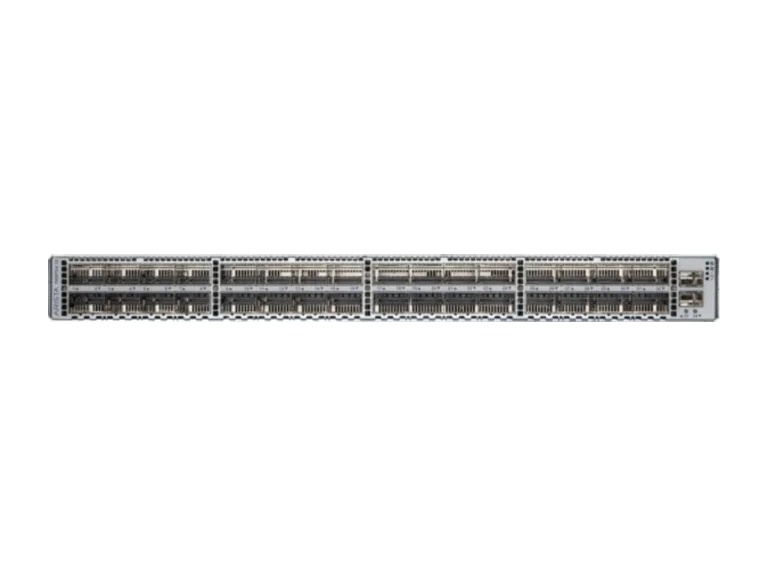
Arista DCS-7060PX5-64E-F — 32×800G OSFP Spine Switch with Forward Airflow
The Arista DCS-7060PX5-64E-F is a 1RU, 32-port 800G spine switch built on the 7060X5 platform with OSFP connector technology. Delivering 25.6 Tbps of non-blocking switching capacity with 825 ns cut-through latency and a 114 MB shared packet buffer, it is purpose-built for the spine layer of high-density 400G/800G leaf-spine fabrics and next-generation AI/ML cluster interconnect and storage networks. The PX5-64E delivers 2× the per-port bandwidth of the 7060DX4-32-F in the same 1RU form factor, with each port operating natively at 800G on OSFP optics and supporting Linear Pluggable Optics (LPO) technology. The “-F” suffix denotes front-to-rear (forward) airflow, the standard configuration for traditional hot-aisle/cold-aisle data center designs where cool air is supplied from the front of the rack. The -64E designation reflects the maximum port configurations supported — up to 64 × 400GbE ports via breakout, or 128 × 200GbE, or higher port counts at lower speeds through breakout cable support.
Key Features at a Glance
- 32 × 800GbE OSFP ports supporting 800G, 400G, 200G, and 100G speeds — up to 256 × 100G interfaces with 8×100G breakout
- 25.6 Tbps non-blocking switching capacity — full wire speed across all 32 ports simultaneously, or 51.2 Tbps in full-duplex mode
- 825 ns cut-through latency for consistent, low-jitter performance across all active ports
- 114 MB shared packet buffer — approximately 2× deeper than the 7060DX4-32-F (64 MB) for AI, storage, and bursty east-west workloads at 800G scale
- OSFP connector with Linear Pluggable Optics (LPO) support for field-upgradeable optics and flexible transceiver configurations
- Advanced switching architecture optimized for 800G OSFP performance and full EOS feature support
- Front-to-rear airflow (“-F”) for standard hot-aisle/cold-aisle data center deployments
- Redundant, hot-swappable power supplies and hot-swappable fan trays
- Full L2/L3 feature set: VXLAN, EVPN, MLAG, 128-way ECMP, BGP, and advanced routing
- Dynamic Load Balancing and Cluster Load Balancing for AI/ML all-reduce and storage traffic patterns
- Rich telemetry: LANZ, sFlow, AEM, and streaming telemetry
- Runs Arista EOS® with open APIs, Python/Bash scripting, and CloudVision® integration
OSFP vs QSFP-DD: The PX5 Platform
The DCS-7060PX5-64E-F is functionally identical to the DCS-7060DX5-64E-F with one critical difference: it uses OSFP (Optical Small Form Factor Pluggable) connectors instead of QSFP-DD. For organizations standardizing on OSFP optics or leveraging Linear Pluggable Optics (LPO) technology for field-upgradeable transceiver configurations, the PX5-64E eliminates the need for separate breakout modules or transceiver adapters.
- OSFP Connector Advantages: Improved thermal management for high-power optics, support for pluggable optics modules that can be field-upgraded without hardware replacement, and direct interoperability with OSFP-based ecosystem partners
- Linear Pluggable Optics (LPO) Support: OSFP supports LPO technology, enabling customers to deploy optics that conform to the Linear Pluggable Transceiver (LPT) specification — a next-generation approach to optics modularity that further reduces total cost of ownership and enables mixed optics deployments across a fabric without dedicated breakout modules
- Identical Performance and Feature Set: The PX5-64E delivers the same 25.6 Tbps throughput, 114 MB buffer, 825 ns latency, and full EOS feature set as the DX5-64E — the only difference is the OSFP interface rather than QSFP-DD
- Software Difference: Minimum EOS version is 4.29.1 (vs 4.31.0 for the DX5-64E), reflecting the platform’s earlier stabilization date
25.6 Tbps Non-Blocking Architecture
The DCS-7060PX5-64E-F delivers 25.6 Tbps of full-duplex, non-blocking switching capacity across all 32 OSFP ports — or 51.2 Tbps in full-duplex bidirectional mode. Every port operates simultaneously at 800G line rate without oversubscription — a critical requirement for spine switches where east-west bandwidth and burst absorption are the architectural constraints. This throughput ceiling holds regardless of traffic mix, packet size distribution, or active flow count, providing the consistent, predictable performance that 800G leaf-spine and AI/ML fabric designs require. A single DCS-7060PX5-64E-F spine can service up to 32 × 800G leaf switches at full line rate, or up to 64 × 400G leaf connections via breakout, or up to 128 × 200G connections — all without fabric head-of-line blocking.
825 ns Cut-Through Latency
Operating in cut-through switching mode, the 7060PX5-64E-F delivers 825 nanoseconds of port-to-port latency with consistent, low-jitter performance across all 32 ports. This sub-microsecond performance is achieved at 800G speeds — a fundamentally harder target than 400G switching, given that 800G ports carry 2× the data volume per clock cycle. The 825 ns latency represents excellent sub-microsecond performance for AI/ML training fabrics, distributed computing, GPU cluster interconnect, and storage networking. The additional latency compared to the 700 ns DX4-32-F is offset by the 2× per-port bandwidth and 114 MB buffer depth that 800G workloads demand.
Port Density and Multi-Speed Flexibility
The 7060PX5-64E provides 32 × OSFP ports, each supporting multiple speeds and breakout configurations:
- 800GbE — native full-rate for 800G spine-to-spine, spine-to-leaf, or DCI connections
- 400GbE — dual 400G operation within a single OSFP port for aggregation or backward-compatible leaf connectivity
- 200GbE — quad 200G operation within a single OSFP port for distributed deployments
- 100GbE — 8× 100G operation within a single OSFP port for connectivity to existing infrastructure via breakout cables
- 4 × 100GbE breakout — connect to 100G leaf switches using standard breakout cables
- 2 × 400GbE breakout — dual 400G connectivity for bonded uplinks or aggregation nodes
This per-port flexibility allows a single 7060PX5-64E spine to simultaneously service native 800G leaf switches, connect to existing 400G leaf infrastructure via breakout, and provide backward-compatible connectivity — covering an entire multi-generation migration without hardware changes.
Optics, Cables, and Interoperability
The DCS-7060PX5-64E-F supports a comprehensive ecosystem of OSFP-based optics and cables:
- 800G OSFP: 800GBASE-DR8, SR8, and other 800G OSFP standards for short-reach and long-reach spine-to-leaf and spine-to-spine connections
- Linear Pluggable Optics (LPO): Field-upgradeable transceiver modules conforming to the Linear Pluggable Transceiver (LPT) specification, enabling flexible optics deployments without hardware changes
- 400G via breakout: OSFP to 2×OSFP breakout for dual 400G configurations
- 200G via breakout: OSFP to 4×OSFP breakout for quad 200G configurations
- Industry-standard optics: Compatible with IEEE 802.3 standards for 800GbE, 400GbE, 200GbE, and 100GbE
114 MB Deep Shared Buffer: Built for 800G AI, Storage, and Synchronized Traffic
The 114 MB shared packet buffer of the PX5-64E is engineered for the most demanding modern workloads. Unlike fixed-per-port buffer architectures, the shared pool dynamically allocates buffer capacity to the ports and queues that need it most — a critical property when traffic is asymmetric, bursty, or subject to many-to-one incast patterns at 800G scale. Three workload categories benefit directly from this buffer depth:
- 800G AI/ML training fabrics: Distributed training jobs at 800G scale with collective operations (AllReduce, AllGather) generate synchronized, simultaneous bursts from hundreds or thousands of GPUs toward the same destination. The 114 MB buffer absorbs these all-reduce events at the spine layer, maintaining GPU utilization and keeping training time predictable.
- High-speed NVMe-oF and storage fabrics: Storage reads and writes at 800G generate large, bursty transfers that arrive in waves. The PX5-64E’s deep shared buffer prevents head-of-line blocking and packet drops that force storage retransmissions and inflate I/O latency.
- East-west incast in 800G leaf-spine fabrics: When multiple leaf switches simultaneously send traffic to the same destination through a spine at 800G rates, the spine port toward that destination absorbs an incast burst many times the individual leaf rate. The 114 MB shared pool provides buffer headroom to absorb these events without drops.
Advanced Load Balancing and Traffic Engineering
The DCS-7060PX5-64E-F supports advanced Arista EOS traffic engineering capabilities that adapt to real-time network conditions:
- Dynamic Load Balancing (DLB): Real-time flow rebalancing for AI/ML all-reduce and storage traffic patterns
- Cluster Load Balancing (CLB): Advanced hashing and traffic steering for GPU cluster traffic
- AI Analyzer: Hardware-based monitoring of ECMP utilization at 100 microsecond granularity
Spine-Optimized Fabric Support: VXLAN, EVPN, and 128-Way ECMP
The 7060PX5-64E-F delivers the full Arista EOS spine feature set for modern data center and AI/ML fabric architectures:
- VXLAN: Spine-layer VXLAN routing for scalable overlay fabrics with large VNI counts across multi-tenant environments
- EVPN: BGP-based control plane for distributed MAC/IP learning, multi-tenancy, and seamless MAC mobility across the fabric
- Up to 128-way ECMP: Maximum path diversity across the spine layer, distributing east-west load evenly across all leaf uplinks
- BGP and IS-IS: Full-featured underlay routing for IP fabric, routed-spine, and eBGP-based CLOS topologies
- MLAG (Multi-Chassis Link Aggregation): Up to 64-way MLAG for redundant dual-homed leaf switch connectivity
RoCEv2 and Lossless Ethernet
The PX5-64E provides full support for lossless Ethernet fabrics required by GPU cluster interconnect:
- RoCEv2 (RDMA over Converged Ethernet): GPU-Direct RDMA support with Per-Priority Flow Control (PFC) for zero-loss fabric operation
- Priority Flow Control (PFC): Per-priority pause mechanism to prevent packet loss during buffer exhaustion
- Data Center Bridging (DCB/DCBX): 802.1Qaz Explicit Congestion Notification (ECN) support for advanced traffic engineering
- Advanced Congestion Control: DCQCN for RoCEv2 flow control optimization
Telemetry, Monitoring, and Real-Time Insight
The DCS-7060PX5-64E-F includes Arista’s full telemetry stack for spine-layer observability at 800G scale:
- LANZ (Latency Analyzer): Per-port, real-time queue depth visibility and microburst detection for diagnosing congestion events at the 800G spine
- sFlow: Continuous traffic sampling for east-west flow analysis and capacity planning
- AEM (Advanced Event Management): Rule-based, programmable alerting for link events, queue thresholds, and routing protocol state changes
- Streaming Telemetry: High-frequency counter and state export to gRPC collectors, Grafana, Prometheus, and third-party NMS tools
EOS Automation and Extensibility
Running on Arista EOS®, the DCS-7060PX5-64E-F is built for automation-first network operations:
- Native on-box Python and Bash scripting via the Linux shell for event-driven automation
- JSON-RPC eAPI for programmatic configuration — integrates with Ansible, Terraform, Salt, and Nornir
- CloudVision® for centralized configuration management, zero-touch provisioning, network-wide change control, and topology visualization
- OpenConfig and gNMI/gRPC for model-driven management and high-frequency streaming state export
- Zero-Touch Provisioning (ZTP) for fully automated day-0 configuration
Front-to-Rear Airflow and Data Center Fit
The “-F” airflow configuration provides front-to-rear (forward) cooling, where cool air enters from the non-port side of the switch and exhausts from the port side. This is the standard configuration for traditional hot-aisle/cold-aisle data center deployments, racks where the majority of equipment already uses front-to-rear airflow, and new data center builds following ASHRAE thermal guidelines. The DCS-7060PX5-64E is available exclusively in front-to-rear (“-F”) airflow. Organizations requiring rear-to-front cooling should evaluate rear-cooled variants or consult with BrightStar Systems for alternative configurations.
Power Efficiency
The DCS-7060PX5-64E-F delivers approximately 18.6 W per active 800G port at typical utilization, with redundant power supplies. The 596W typical power draw for a 32-port 800G OSFP spine switch demonstrates excellent power efficiency relative to the bandwidth delivered. Dual redundant, hot-swappable power supplies ensure continuous operation through PSU failures without scheduled maintenance windows.
Reliability and High Availability
The DCS-7060PX5-64E-F is engineered for 24/7/365 operation in mission-critical fabrics:
- Stateful Fault Repair (SFR): Automatic detection and healing of transient packet forwarding errors without traffic interruption
- Stateful Fault Containment (SFC): Isolation of faulty hardware components to prevent cascading failures
- Smart System Upgrade (SSU): Graceful hitless OS upgrades without traffic disruption or connection loss
- Accelerated Software Update (ASU): Fast in-place OS updates with minimal downtime
Deployment Scenarios and Industry Applications
- 800G AI/ML Training Fabrics with OSFP Optics: Organizations standardizing on OSFP for their 800G optics ecosystem — the PX5-64E provides native 800G OSFP connectivity with 114 MB buffer, DLB/CLB load balancing, and LANZ telemetry optimized for GPU cluster all-reduce traffic at 800G scale. Ideal for AI research facilities and hyperscale operators leveraging OSFP-based infrastructure investments.
- Linear Pluggable Optics (LPO) Deployments: Organizations evaluating or standardizing on LPO technology for field-upgradeable transceiver configurations — the OSFP connector enables direct LPO module compatibility without separate conversion or breakout adapters, reducing total cost of ownership across the fabric lifecycle.
- 400G/800G Mixed-Generation Leaf-Spine Fabrics: Using breakout cables, the PX5-64E connects to existing 400G OSFP leaf infrastructure today while supporting native 800G leaf uplinks as the fabric upgrades.
- Ultra-High-Throughput NVMe-oF Storage Fabrics: 25.6 Tbps non-blocking capacity with 114 MB buffer depth for storage networks where burst tolerance at the spine layer directly determines storage I/O consistency and tail latency.
- Hyperscale and Cloud Data Centers: 25.6 Tbps non-blocking spine capacity with 128-way ECMP and 800G per-port OSFP bandwidth for full-bisection-bandwidth cloud fabric designs.
Lifecycle, Reliability, and Future-Proofing
The 7060PX5-64E-F is built for long operational lifecycles with high MTBF ratings, field-replaceable fans and power supplies, and the consistent Arista EOS release cadence that network teams depend on for long-term supportability. As 800G becomes the standard fabric speed for next-generation AI/ML clusters, the PX5-64E is positioned as a long-lived spine asset. For organizations investing in OSFP and LPO technology paths, the PX5-64E provides a stable platform for 800G fabrics with protected transceiver and optics investments through pluggable module upgrades.
Similar Arista 7060 Models to Consider
- Arista DCS-7060DX5-64E-F – 32×800G QSFP-DD variant with identical specs except for QSFP-DD interface. Use when QSFP-DD optics are preferred.
- Arista DCS-7060DX4-32-F – 32×400G 7060DX4 spine with 64 MB buffer and 700 ns cut-through latency on QSFP-DD interface. The right choice when 400G is sufficient.
- Arista DCS-7060CX2-32S-F – 32×100G 7060CX2 spine with 22 MB buffer and 450 ns cut-through latency. The right choice when 100G is sufficient and sub-500 ns latency is required.
Related 7060X Resources
Arista 7060 Series Switches: Architecture, Models, and Deployment Guide
The 800G OSFP Spine Built for Next-Generation AI, Storage, and OSFP-First Deployments
The Arista DCS-7060PX5-64E-F brings together 25.6 Tbps of non-blocking capacity, 32 native 800G OSFP ports with Linear Pluggable Optics support, 114 MB of shared packet buffer, and the full depth of Arista EOS automation into a 1RU spine switch built for organizations standardizing on OSFP optics and LPO technology. Its front-to-rear airflow makes it the natural fit for standard hot-aisle/cold-aisle data center deployments, and its multi-speed OSFP ports protect existing 100G/200G/400G infrastructure investments while enabling a clean migration to 800G. Available from BrightStar Systems fully tested, reset to factory defaults, and backed by a 5-year in-house warranty.
Related Arista 7060X Series models:
DCS-7060X6-64PE-F and
DCS-7060CX-32S-F.